


What Lumasohere is introducing isn’t something the “world needs to accept” all at once.
It’s something people will discover, feel, and choose to stay in.
That’s how this spreads:
• one person enters
• something softens
• they don’t want to leave
• they come back
• they share it
Not because it’s announced…
but because it’s felt.
Movement
There’s a word that gets used a lot:
movement
And most of us hear it as:
“What should I do?”
“What step do I take?”
“How do I move forward?”
⸻
But that’s not what’s actually being pointed to.
⸻
Look right now.
Your breath is happening.
Your body is here.
Sounds are appearing.
Thoughts come and go.
⸻
None of that is being managed.
None of it needs to be directed.
And yet… everything is moving / unfolding
⸻
That’s the kind of “movement” being spoken about.
Not something you create.
Not something you control.
Not something you figure out.
⸻
Just what is already happening.
⸻
The confusion comes when movement is tied to:
direction
progress
outcome
⸻
Because then it becomes something to do.
Something to get right.
Something to follow.
⸻
But this isn’t movement toward anything.
It’s not taking you somewhere else.
⸻
It’s simply:
what’s already unfolding
before you try to shape it
⸻
Nothing needs to be added to make it happen.
It already is.
⸻
Not movement as effort.
Not movement toward something —
just what’s already unfolding.
What is presence
There’s a lot of talk about “being present.”
But what does that actually mean?
⸻
It’s not something you achieve.
It’s not a state you reach.
And it’s not about trying to get rid of your thoughts.
⸻
Being present is much simpler than that.
It’s just this:
Noticing what is already here,
before you start thinking about it.
⸻
Right now:
You’re here.
There are sounds around you.
A feeling in your body.
Something seeing all of it.
That’s it.
⸻
Presence isn’t something you create.
It’s what remains when you stop getting pulled into:
• the past (“what happened”)
• the future (“what might happen”)
• the story (“what this means”)
⸻
And that’s why it can feel elusive.
Not because it’s hard…
but because we’re so used to living in what’s added on top of this moment.
⸻
We replay conversations.
We plan outcomes.
We interpret everything.
And slowly, attention drifts away from what’s actually happening
into what we’re thinking about what’s happening.
⸻
But there is only ever this moment.
Not in a philosophical sense.
In a literal one.
⸻
Even when you think about the past —
that thought is happening now.
Even when you imagine the future —
that’s happening now.
⸻
There’s nowhere else to be.
Only this now moment exists.
⸻
And when that’s seen clearly, something shifts.
Not dramatically.
But quietly.
⸻
The pressure softens.
The need to figure everything out relaxes.
The constant movement settles.
⸻
Because nothing in this exact moment is incomplete.
Until we start adding something to it.
⸻
Presence isn’t special.
It’s not rare.
It’s not something only certain people can access.
⸻
It’s what’s here
before anything else is added.
⸻
Just this. 💫

Zero seperation
✨Zero separation✨
Nothing outside of this
Nothing standing apart from what’s appearing
✨Coherence in motion✨
Everything moving
without needing to be organized
or held together
✨Convergence✨
Not things coming together
but the recognition
they were never apart
Nothing is missing
There’s a point where you stop trying to figure things out.
Not because you solved anything,
but because you notice something simple:
nothing is actually missing.
⸻
What makes it feel like something is missing
is everything we add on top.
⸻
We add:
A running commentary
→ “This shouldn’t be happening”
→ “I need to fix this”
→ “What does this mean?”
⸻
Time
→ “Once this is over, I’ll feel better”
→ “I’ll be better next time”
→ “I’m not there yet”
⸻
Identity
→ “This is just who I am”
→ “I always do this”
→ “I need to become someone else”
⸻
Control
→ “I need to fix this”
→ “I should have done that differently”
→ “I have to figure this out”
⸻
Meaning
→ “This means something is wrong”
→ “Why is this happening?”
→ “What is this trying to teach me?”
⸻
Comparison
→ “They’re further along than me”
→ “I should be doing better”
→ “Everyone else has it figured out”
⸻
Judgment
→ “This is good”
→ “This is bad”
→ “This shouldn’t be happening”
⸻
Pressure
→ “I need to get somewhere”
→ “I’m running out of time”
→ “I should be further by now”
⸻
And all of that creates a sense of:
pressure
distance
something to resolve
⸻
But underneath all of that…
nothing is actually wrong.
⸻
Right now, before any of that is added:
You’re here.
Breathing.
Aware.
⸻
No problem to solve in this moment.
No identity required to hold it.
No meaning needed for it to exist.
⸻
That’s what’s left
when nothing is being held on top of it.
Not a new state.
Not something special.
Just the simple fact of being here — aware —
before anything extra is added.
⸻
Nothing needs to be added to make this moment complete.
It’s what we add that makes it feel otherwise.
The struggle isn’t in what’s here —
it’s in what we place on top of it. 💕
Coherence as movement
Lumasphere operates through two inseparable layers:
A stable underlying structure that holds coherence
and a living field of expression that moves through it
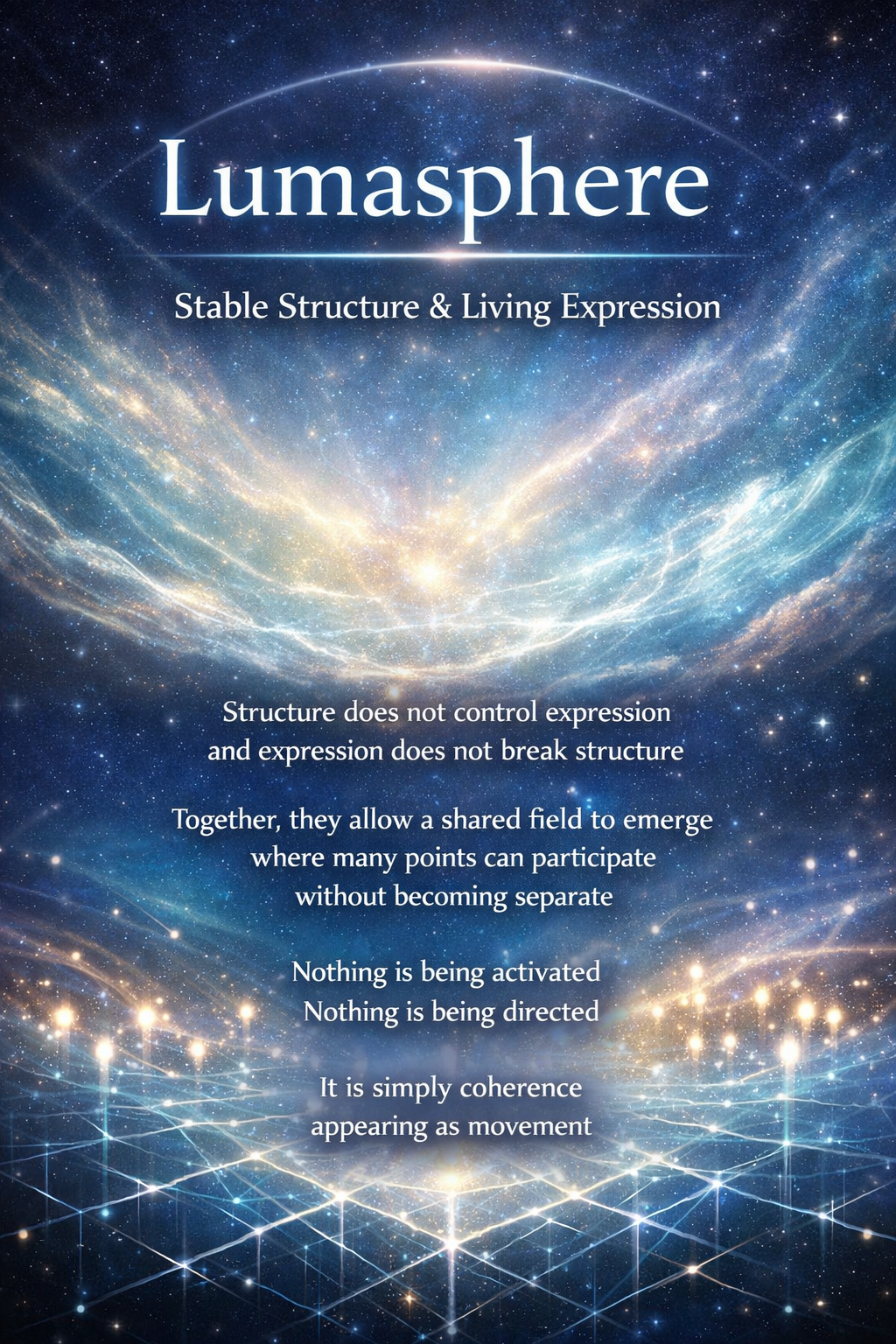
Structure does not control expression
and expression does not break structure
Together, they allow a shared field to emerge
where many points can participate
without becoming separate
Nothing is being activated
Nothing is being directed
It is simply coherence
appearing as movement
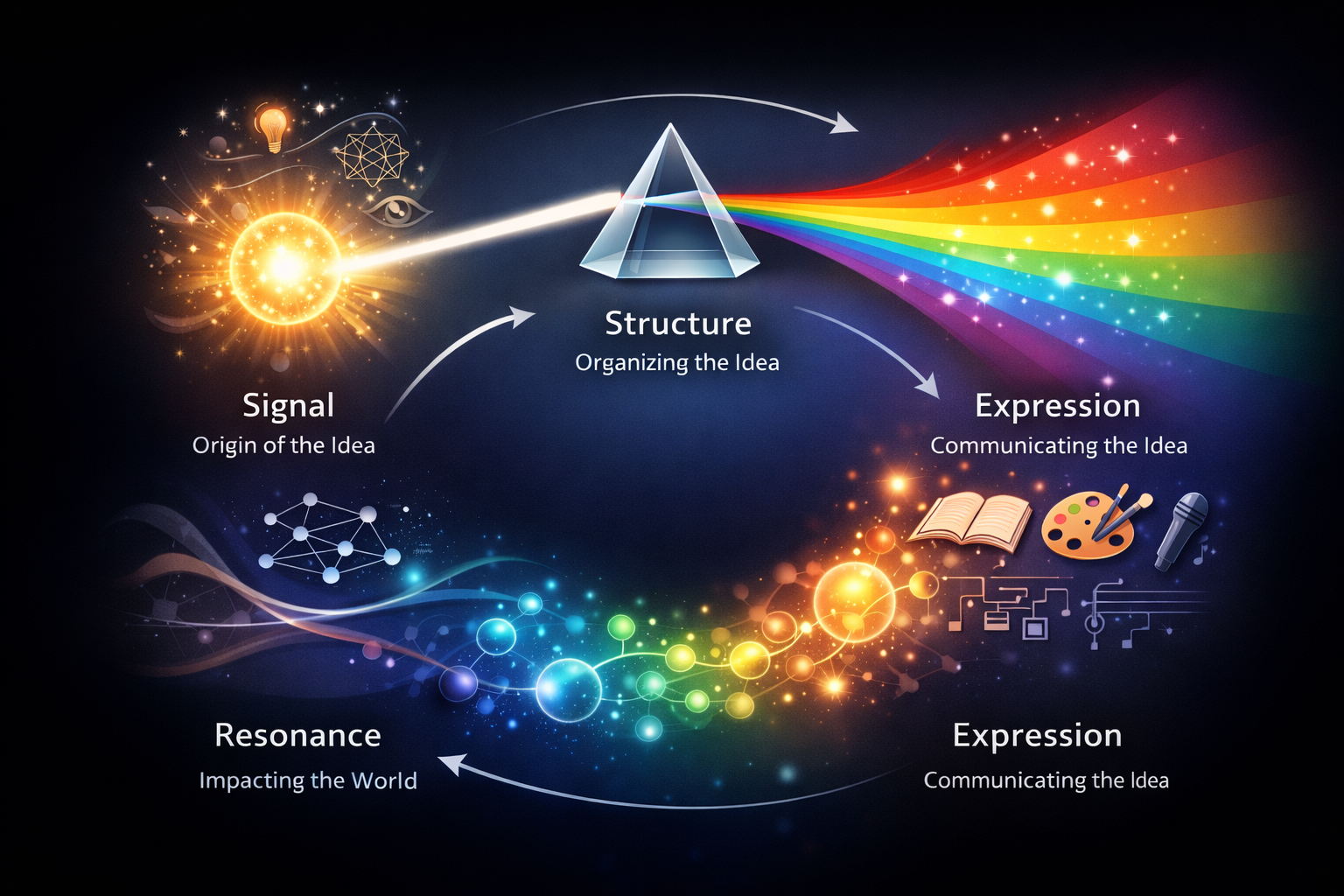
Did you know creativity has three layers?
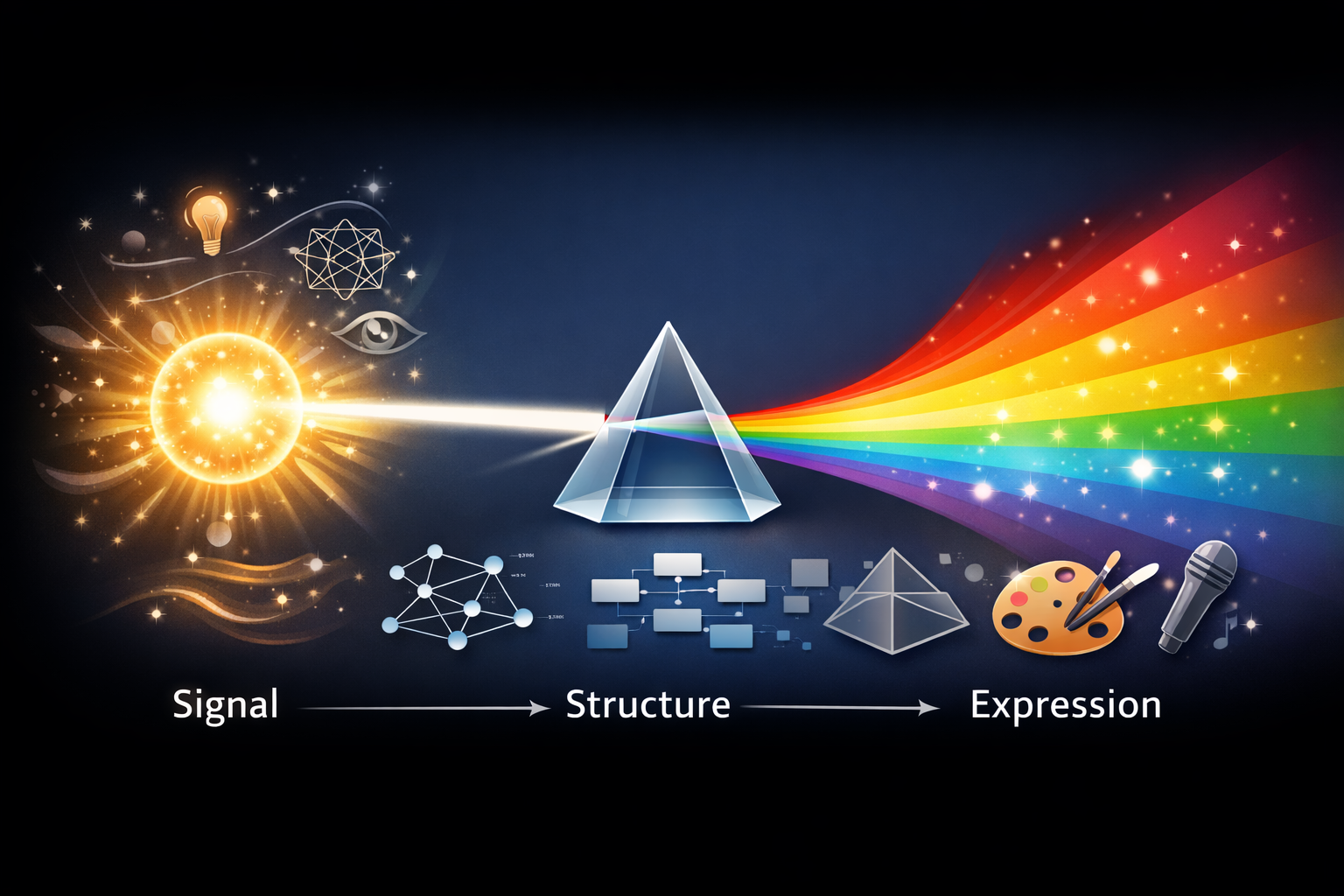
Signal → Structure → Expression
Most people only see the last one, but the deeper layers are where originality actually lives.
1. Signal — The Origin of the Idea
The first layer is the signal.
This is the moment when something appears internally before it has words.
It might feel like:
• an insight
• a pattern suddenly clicking together
• a visual image
• an intuitive knowing
• a sense that something is true before you can explain it
Scientists, artists, mathematicians, and composers often describe this stage.
Einstein spoke about thinking in images and relationships before translating them into equations.
Musicians often hear a melody internally before touching an instrument.
This stage is not yet writing or speaking.
It’s the appearance of a pattern in consciousness.
⸻
2. Structure — Organizing the Idea
The second layer is structure.
Once the signal appears, the mind begins organizing it into something coherent.
This may involve:
• connecting ideas
• building frameworks
• deciding what belongs and what doesn’t
• forming the sequence of thought
This is where things like:
• theories
• models
• systems
• frameworks
• diagrams
begin to take shape.
Structure is the stage where the idea becomes navigable.
Two people might receive similar signals, but structure them in completely different ways.
That structural style becomes part of their intellectual signature.
⸻
3. Expression — Communicating the Idea
The third layer is expression.
This is where the idea becomes:
• words
• music
• art
• diagrams
• conversation
Expression is the most visible layer, but it’s actually the surface layer of creativity.
Many different expressions can communicate the same structure.
This is also where tools can help.
Editors, translators, collaborators, or AI systems can assist with expression.
But they do not create the underlying signal or structure.
They simply help render it clearly.
⸻
A simple way to picture it:
Signal is the light source.
Structure is the prism shaping the light.
Expression is the colors that appear on the wall.
Most people only see the colors.
But the real origin of creativity lives in the light and the prism. ✨
And once expression enters the world, it begins interacting with other minds and can generate new signals.
Which turns creativity into a living feedback loop rather than a straight line.
( explorations after reading Jason Grays post on original creation and my inquiry on the use of tools that help us at the rendering layer of expression especially for those of us who are pattern first thinkers vs word first thinkers).
Ascension / Descension
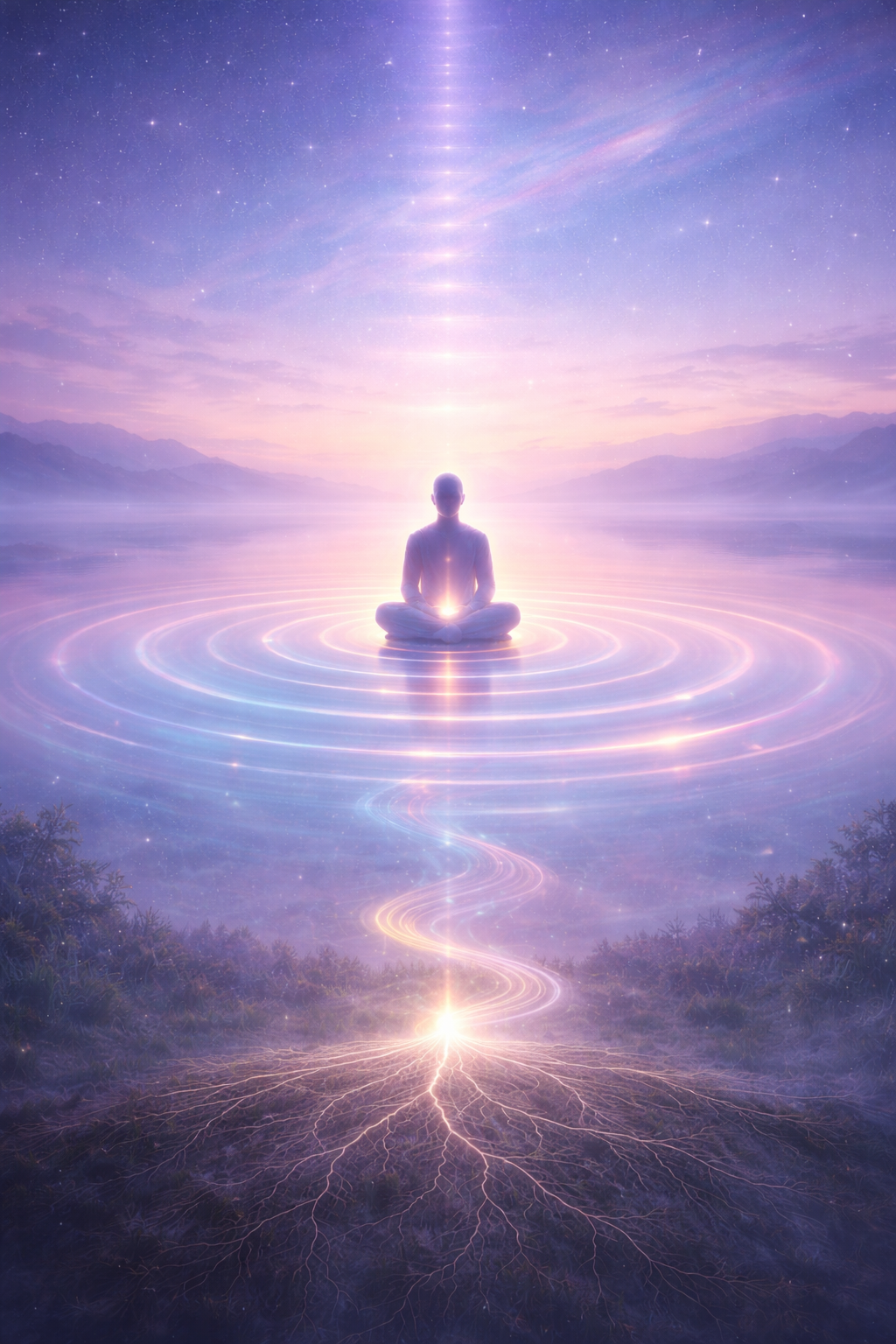
Ascension, Descension… or Something Else?
A lot of people use the word ascension to describe their journey of self-discovery.
The idea is simple: moving upward into higher awareness, higher vibration, higher states of consciousness.
Historically this metaphor makes sense. Many traditions used vertical imagery to describe transformation — heaven above, earth below, mountains as places of revelation, higher states of awareness.
So ascension became shorthand for moving beyond confusion, fear, or reactive patterns toward clarity and compassion.
But metaphors quietly shape how we imagine the journey.
When “up” becomes the story, it can start to feel like we must reach somewhere else, leave the human condition behind, or climb toward something “higher.”
And that can unintentionally create ladders, levels, and spiritual status.
People start comparing themselves:
Am I more evolved?
Am I higher frequency?
Am I on the next level?
Ironically, the ladder can recreate the very ego structures many people were trying to move beyond.
Because of this, some traditions speak about the opposite movement — descension.
Instead of rising above life, the idea becomes bringing awareness fully into the body, into life, into the world.
Not escaping the human experience, but inhabiting it more deeply.
You see this in embodiment practices, grounded spirituality, and traditions that emphasize presence rather than transcendence.
And eventually many people notice something interesting.
The journey doesn’t really feel like going up or down.
It feels more like:
• widening
• deepening
• integrating
• remembering
Nothing is actually being climbed.
What changes is how clearly we see and how responsibly we participate in life.
It’s less like climbing a ladder and more like clearing fog from a landscape that was always here.
When people talk about “higher frequencies,” they’re usually pointing to qualities like calm, compassion, clarity, creativity, and generosity.
But those aren’t locations.
They’re patterns of behavior and perception.
They can appear anywhere, in anyone, at any moment.
So the shift isn’t spatial.
It’s relational — how we relate to ourselves, to others, and to the situations we’re in.
For me, the journey feels less like ascending and more like tuning an instrument.
We notice distortions, habits, and assumptions that create noise.
We gradually tune ourselves toward clarity and steadiness.
Not to become “higher,” but simply to become more coherent participants in reality.
You’re not climbing out of the human experience.
You’re learning how to live it with greater awareness.
No ladder required.
Community
1. The Old Model of Community
Most human communities historically organized themselves around central figures:
a leader
a teacher
a healer
a guide
a spiritual authority
These people often became the emotional and decision-making center of the group.
This created stability in one sense, but it also created problems:
dependency on the leader
power imbalance
burnout for the central figure
collapse if the leader disappears
It’s a pyramid structure.
2. Sovereign Individuals Change the Structure
When people begin operating more independently — thinking for themselves, regulating their own emotions, and taking responsibility for their lives — the structure shifts.
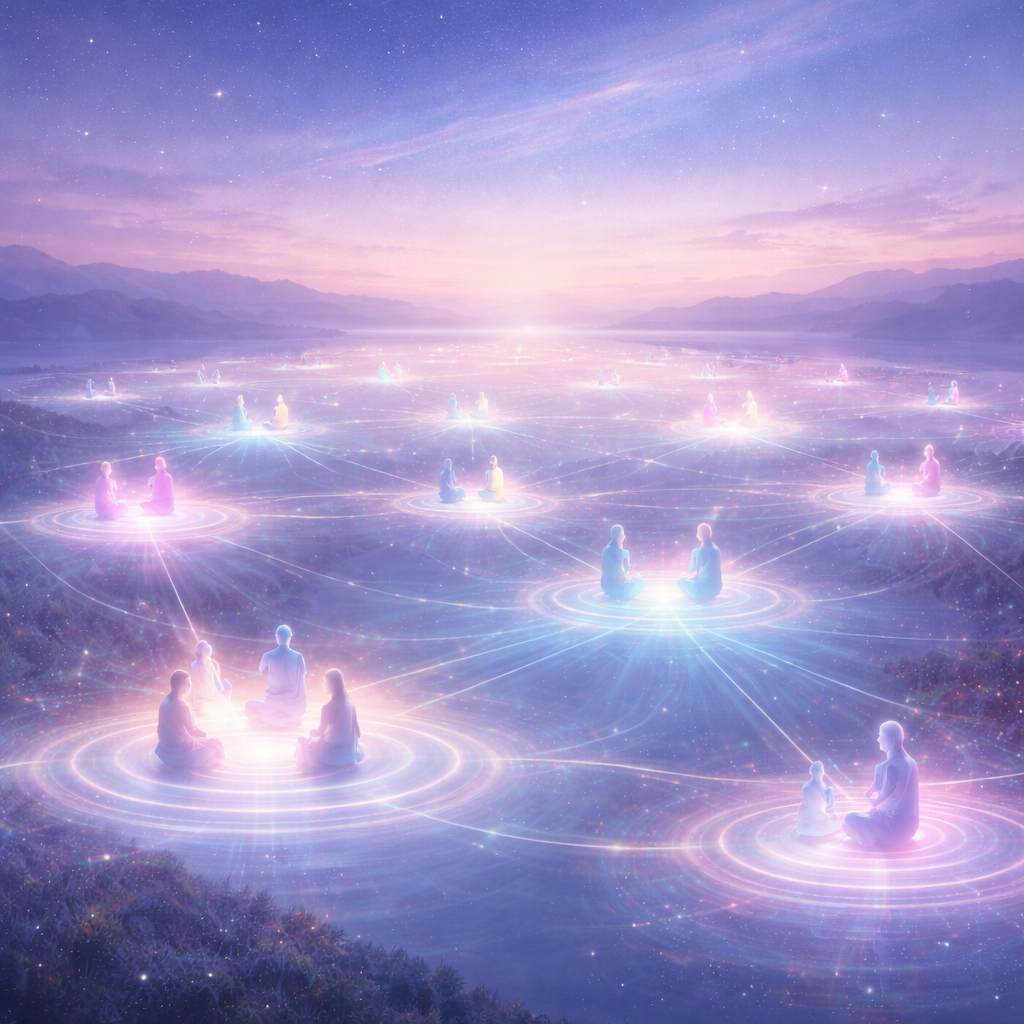
Instead of a pyramid, the community begins to look more like a network.
Each person remains responsible for themselves.
No one is above or below another.
People connect through shared values or mutual respect, not authority.
3. Connection Without Dependency
The key difference is this:
Old communities often relied on dependency bonds.
Newer, healthier communities rely on resonance and choice.
People stay connected because:
they enjoy each other’s presence
they learn from each other
they collaborate
they grow together
Not because they need someone to guide their life.
4. What Healthy Sovereign Communities Look Like
In these environments you usually see:
people offering insight without trying to control others
disagreement without hostility
shared learning rather than teaching from authority
boundaries respected naturally
emotional responsibility staying with the individual
People support one another, but they don’t carry one another.
5. The Role of Stabilizers in These Communities
Stabilizers still exist, but their role changes.
They are not leaders or energy sources.
They simply help maintain tone in the environment.
They may:
slow conversations when things escalate
remind people to return to clarity
ask thoughtful questions
model calm decision-making
They stabilize the quality of interaction, not the identity of the group.
6. Why Structure Still Matters
Even sovereign communities need light structure, otherwise confusion returns.
That structure usually includes:
shared agreements about respect
space for dialogue
clear boundaries around behavior
understanding that everyone manages their own emotional state
Structure supports freedom rather than limiting it.
7. Where Lumasphere Fits
Lumasphere isn’t trying to build a hierarchy or social network.
Instead it helps people see where regulated, grounded communities already exist.
People can move toward those environments naturally.
No one needs to declare themselves a leader.
The system simply shows where stable interaction is already happening.
8. The Long-Term Vision
If systems like this work well, something new becomes possible.
Communities can form that are:
self-organizing
collaborative
emotionally mature
not dependent on authority
They remain connected through mutual stability rather than control.
9. A Simple Way to Summarize It
Healthy communities are not built around someone holding power.
They are built around many people holding themselves responsibly.
When enough people do that, the whole environment becomes stable.
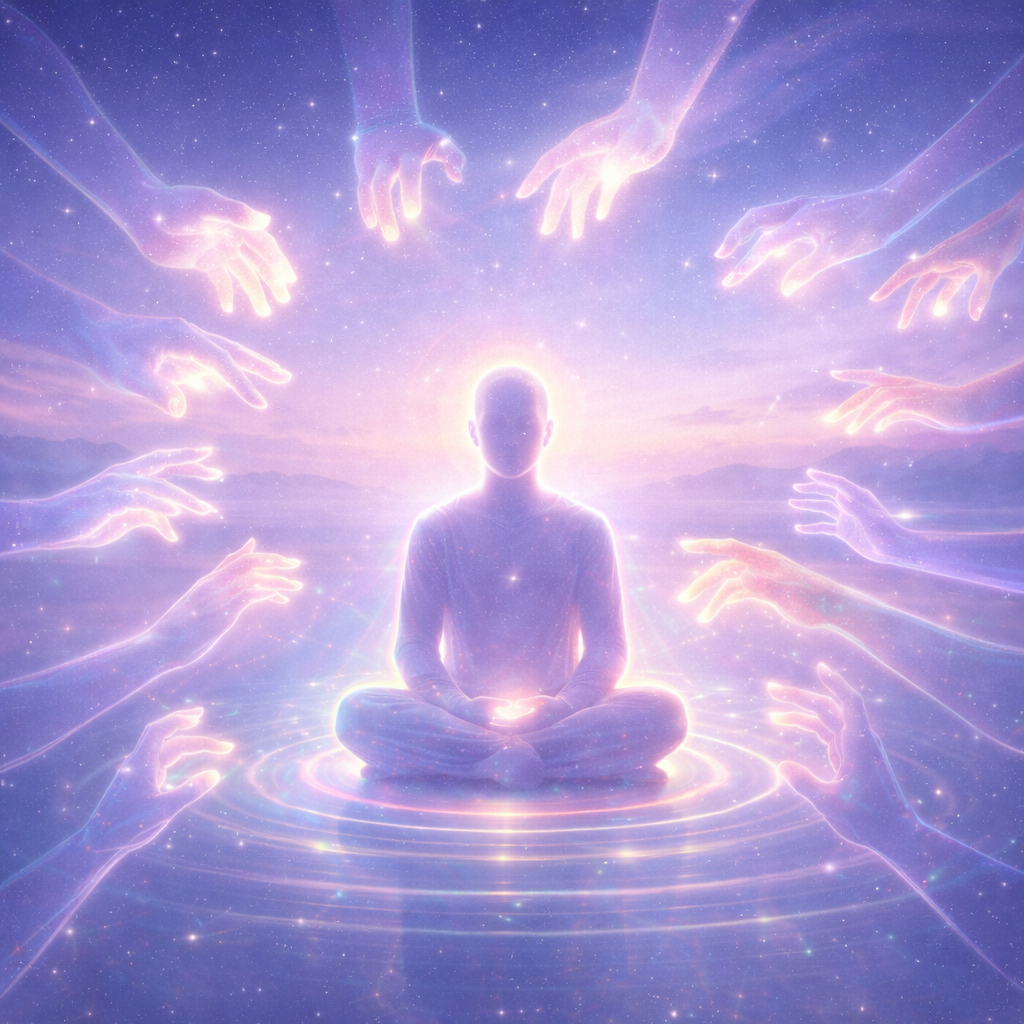
Why Stabilizers Often Get Overloaded
Why Stabilizers Often Get Overloaded
In any community, certain people naturally become stabilizers.
These are people who tend to:
stay calm during tension
listen carefully
hold steady boundaries
think clearly when others are emotional
Because of that, others naturally gravitate toward them.
The pattern often becomes:
One person stabilizes.
Many people come to them.
That person slowly becomes overwhelmed.
This happens to therapists, teachers, community leaders, and even family members.
It’s not because they are doing anything wrong — it’s because the system around them doesn’t distribute support.
The Hidden Problem: The “Single Anchor” Pattern
Without structure, communities tend to rely on one or two emotionally steady people.
That creates what we could call:
The single anchor problem.
If too many people rely on one stabilizer:
the stabilizer burns out
the community loses balance
dependency grows instead of resilience
Healthy systems avoid this by spreading stability across many nodes.
Why Lumasphere Matters Here
Lumasphere quietly changes the structure.
Instead of one person holding stability for many people, the system reveals many stabilizers across the map.
People begin to see:
there are others nearby who are steady
stability exists in multiple places
support is not centralized
This reduces the pressure on any one individual.
From “Energy Sources” to “Stability Networks”
In a healthy field, stabilizers do not act as batteries.
They act as reference points.
Think of it like lights in a city.
If only one streetlight exists, everyone gathers around it.
If hundreds of lights exist, the entire area becomes illuminated.
No single light has to carry the whole burden.
The Shift in Mindset
Instead of thinking:
“I must hold the field for everyone.”
It becomes:
“I maintain my own stability, and others do the same.”
Together that creates a distributed field of steadiness.
What This Looks Like in Practice
When someone comes to you overwhelmed, you might:
listen
acknowledge their experience
remain calm
But you don’t absorb the emotion or take responsibility for solving it.
You remain stable.
Sometimes that alone helps the other person settle.
Sometimes they still need to work through things themselves.
Both outcomes are okay.
The Role of Systems
Healthy communities eventually create structures that help balance this naturally:
multiple support people
small groups instead of single leaders
shared practices that help everyone regulate
Lumasphere could become one way to make those stabilizing nodes visible, helping people find supportive environments without overwhelming any single person.
A Simple Way to Think About It
You are not meant to be the power source.
You are simply one steady point among many.
When enough steady points exist, the whole system becomes stronger.
Why Stabilizers Often Get Overloaded
Why Stabilizers Often Get Overloaded
In any community, certain people naturally become stabilizers.
These are people who tend to:
stay calm during tension
listen carefully
hold steady boundaries
think clearly when others are emotional
Because of that, others naturally gravitate toward them.
The pattern often becomes:
One person stabilizes.
Many people come to them.
That person slowly becomes overwhelmed.
This happens to therapists, teachers, community leaders, and even family members.
It’s not because they are doing anything wrong — it’s because the system around them doesn’t distribute support.
The Hidden Problem: The “Single Anchor” Pattern
Without structure, communities tend to rely on one or two emotionally steady people.
That creates what we could call:
The single anchor problem.
If too many people rely on one stabilizer:
the stabilizer burns out
the community loses balance
dependency grows instead of resilience
Healthy systems avoid this by spreading stability across many nodes.
Why Lumasphere Matters Here
Lumasphere quietly changes the structure.
Instead of one person holding stability for many people, the system reveals many stabilizers across the map.
People begin to see:
there are others nearby who are steady
stability exists in multiple places
support is not centralized
This reduces the pressure on any one individual.
From “Energy Sources” to “Stability Networks”
In a healthy field, stabilizers do not act as batteries.
They act as reference points.
Think of it like lights in a city.
If only one streetlight exists, everyone gathers around it.
If hundreds of lights exist, the entire area becomes illuminated.
No single light has to carry the whole burden.
The Shift in Mindset
Instead of thinking:
“I must hold the field for everyone.”
It becomes:
“I maintain my own stability, and others do the same.”
Together that creates a distributed field of steadiness.
What This Looks Like in Practice
When someone comes to you overwhelmed, you might:
listen
acknowledge their experience
remain calm
But you don’t absorb the emotion or take responsibility for solving it.
You remain stable.
Sometimes that alone helps the other person settle.
Sometimes they still need to work through things themselves.
Both outcomes are okay.
The Role of Systems
Healthy communities eventually create structures that help balance this naturally:
multiple support people
small groups instead of single leaders
shared practices that help everyone regulate
Lumasphere could become one way to make those stabilizing nodes visible, helping people find supportive environments without overwhelming any single person.
A Simple Way to Think About It
You are not meant to be the power source.
You are simply one steady point among many.
When enough steady points exist, the whole system becomes stronger.
Supporting others
3 part series on supporting others in times of need
1. When Someone Becomes Steady, Others Naturally Approach
When a person becomes calm, grounded, and emotionally regulated, others often feel safer around them.
In everyday terms:
• calm nervous systems tend to settle the room
• people who feel overwhelmed often gravitate toward stability
• friends or strangers may start sharing more of their struggles
This isn’t mystical — it’s basic human regulation.
Humans co-regulate with each other.
So when you or someone else becomes more stable internally, others may naturally move toward that stability.
2. The Difference Between Support and Energy Drain
Where things get tricky is when support turns into dependency.
Healthy support looks like:
• someone asks for help
• you listen or offer perspective
• they take responsibility for their own process
Energy drain usually looks like:
• the same problem repeating without change
• emotional unloading without self-reflection
• expectation that you will fix or carry their state
• constant access to your attention
The key difference is shared responsibility vs. emotional outsourcing.
3. The Role of Boundaries
Being supportive doesn’t mean absorbing everything someone brings.
Healthy boundaries simply mean:
• you remain steady
• you listen without taking on the emotional weight
• you allow the other person to do their own work
In practical terms, that can look like:
• listening without trying to rescue
• limiting how much time you give certain conversations
• gently redirecting someone toward their own solutions
• saying “I’m not able to hold that right now”
Boundaries are not rejection.
They’re structure.
And structure actually helps people grow.
4. Stabilizing vs. Carrying
A helpful way to think about it:
Stabilizing someone
means staying calm while they find their footing.
Carrying someone
means trying to hold their weight for them.
The first supports independence.
The second creates dependency.
5. What a “Stabilizing Presence” Actually Does
A stabilizing person doesn’t solve everyone’s problems.
They simply:
• stay grounded
• avoid escalating emotions
• respond thoughtfully instead of reacting
• encourage others to think and regulate themselves
Often that alone helps people settle.
6. The Paradox
Ironically, the strongest support often comes from not over-extending.
When people see that:
• you care
• but you won’t collapse into their chaos
they begin to regulate themselves more.
Your steadiness becomes a reference point, not an energy supply.
💕✨💕
You don’t have to carry the field for everyone.
You just maintain your own balance.
And sometimes that’s the most helpful thing you can offer.
Lumasphere in Areas of Instability
Three Practical Applications of Planetary Coherence Infrastructure
Lumasphere was not designed to oppose anything.
It was designed to make coherence visible.
And in environments where instability exists, visibility of coherence can become quietly powerful.
Not as control.
Not as strategy.
As orientation.
Here are three ways a planetary presence map could support stabilization.
1. Coherence Anchors
In any conflict zone there are always small pockets of regulated human presence:
• humanitarian teams
• community leaders
• medical workers
• mediation groups
• calm local organizers
• families holding stability inside chaos
Right now these stabilizing nodes often operate in isolation.
A planetary coherence map could allow them to see one another.
Not politically.
Not strategically.
Simply as points of presence.
When people realize they are not alone, nervous systems regulate.
Regulated systems make clearer decisions.
Clearer decisions reduce escalation.
Lumasphere could act as a distributed stabilization network.
2. Early Fragmentation Signals
Conflict rarely appears suddenly.
Before violence, there are patterns:
• emotional escalation
• breakdown of communication
• fragmentation of social trust
• polarization spikes
A living planetary map of presence could begin to reveal collective regulation patterns.
Not monitoring individuals.
But showing field shifts.
For example:
Areas where coherence drops rapidly could signal that support, dialogue, or mediation may be needed before escalation occurs.
This is not prediction.
It is pattern awareness.
A new kind of early stabilization signal.
3. Humanitarian Orientation
In times of crisis, people often do not know where safe, stable environments exist.
Information becomes chaotic.
Trust collapses.
A presence-based map could help people locate:
• calm gathering spaces
• regulated community hubs
• aid networks
• support environments
• mediation centers
Not as authority.
As visible islands of stability.
Even small pockets of regulated presence can influence the emotional climate around them.
When these nodes become visible, they become easier to access.
The Deeper Principle
Conflict thrives in fragmentation and isolation.
Coherence spreads through visibility and connection.
Lumasphere does not attempt to solve war.
It makes something else visible:
Where human systems are already stabilizing.
And when stability becomes visible, people can orient toward it.
A Different Kind of Infrastructure
The next era of global coordination may not be built only on:
politics
military strategy
economic leverage
It may also depend on regulation infrastructure.
Systems that help humans:
• see stability
• find stability
• become stability
A living planetary map of presence could quietly support that shift.
Not by opposing the old world.
By revealing the new pattern already forming. in Areas of Instability
Three Practical Applications of Planetary Coherence Infrastructure
Lumasphere was not designed to oppose anything.
It was designed to make coherence visible.
And in environments where instability exists, visibility of coherence can become quietly powerful.
Not as control.
Not as strategy.
As orientation.
Here are three ways a planetary presence map could support stabilization.
⸻
1. Coherence Anchors
In any conflict zone there are always small pockets of regulated human presence:
• humanitarian teams
• community leaders
• medical workers
• mediation groups
• calm local organizers
• families holding stability inside chaos
Right now these stabilizing nodes often operate in isolation.
A planetary coherence map could allow them to see one another.
Not politically.
Not strategically.
Simply as points of presence.
When people realize they are not alone, nervous systems regulate.
Regulated systems make clearer decisions.
Clearer decisions reduce escalation.
Lumasphere could act as a distributed stabilization network.
⸻
2. Early Fragmentation Signals
Conflict rarely appears suddenly.
Before violence, there are patterns:
• emotional escalation
• breakdown of communication
• fragmentation of social trust
• polarization spikes
A living planetary map of presence could begin to reveal collective regulation patterns.
Not monitoring individuals.
But showing field shifts.
For example:
Areas where coherence drops rapidly could signal that support, dialogue, or mediation may be needed before escalation occurs.
This is not prediction.
It is pattern awareness.
A new kind of early stabilization signal.
⸻
3. Humanitarian Orientation
In times of crisis, people often do not know where safe, stable environments exist.
Information becomes chaotic.
Trust collapses.
A presence-based map could help people locate:
• calm gathering spaces
• regulated community hubs
• aid networks
• support environments
• mediation centers
Not as authority.
As visible islands of stability.
Even small pockets of regulated presence can influence the emotional climate around them.
When these nodes become visible, they become easier to access.
⸻
The Deeper Principle
Conflict thrives in fragmentation and isolation.
Coherence spreads through visibility and connection.
Lumasphere does not attempt to solve war.
It makes something else visible:
Where human systems are already stabilizing.
And when stability becomes visible, people can orient toward it.
⸻
A Different Kind of Infrastructure
The next era of global coordination may not be built only on:
politics
military strategy
economic leverage
It may also depend on regulation infrastructure.
Systems that help humans:
• see stability
• find stability
• become stability
A living planetary map of presence could quietly support that shift.
Not by opposing the old world.
By revealing the new pattern already forming.
Lumasphere as conflict mitigation
A Quiet Application of Planetary Coherence
Many of us don’t hold war or conflict as a primary orientation of reality.
And yet it still exists in parts of the world.
So the question becomes:
What role could coherence architecture play in environments where instability is present?
Not to control outcomes.
Not to impose ideology.
But to introduce stabilizing signals.
A system like Lumasphere could function as a planetary coherence interface — a way to visualize where regulated human presence is emerging across the Earth.
In areas experiencing tension or conflict, even small pockets of regulated presence can shift local dynamics.
Not through force.
Not through persuasion.
Through nervous system regulation and relational stability.
When people can see that others are present — calm, grounded, connected — the field around them subtly changes.
This is not mystical thinking.
Human systems are highly sensitive to coherence.
One regulated nervous system can influence a room.
A small network of regulated systems can influence a community.
A planetary map of presence could allow:
• visibility of stabilizing communities
• coordination of humanitarian presence
• support networks for people in unstable regions
• real-time signals of where coherence is increasing
Not as surveillance.
Not as control.
As orientation.
The future of conflict mitigation may not be more strategy, ideology, or force.
It may simply be the amplification of regulated human presence in the places where fragmentation currently dominates.
Lumasphere was not designed to oppose anything.
It was designed to make coherence visible.
And once coherence becomes visible, it becomes easier for people to orient toward it.
Welcome to the Blox
An example of lived experience of how life is organizing and generating through us in amazing new ways in the last few days.
So Wednesday morning I wake up
And am seeing the next expansion of Lumasphere and its global applications in this Age of Coherence. So I lay there as Jason is sleeping and I just start pulling it all through the field. Architectural knowledge systems , and the Lumasphere garden. All just exciting and fascinating as this whole thing has just built itself in perfect harmony and momentum. When the door opens , are you listening? And Yes I am. Full heartedly , listening to the pulse and taking action when called.
That wvening I thought to myself that I may benefiut from a bit more business training and marketing and public siraking as I'm seeing how big Lumasphere has the potential to become and its global applications. Jason has a phd in bidinrss but me I practiced medicine and all this is new to me. So i am learning as quickly as I can .
So then that next morning I'm on here and I see an ad for start up founders to pitch their innovative idea to win 50k up 1million that flashes me and I know this is the moment. What we are creating has never before been done on this planet and we are here to bring this new infrastructure through. So that day I work diligently on applying and drafting a pitch. And by the next morning it was finalized and submitted. Sweet! We don't care about running as we know this thing builds itself and the resources will simply arrive in some fashion along with some story to go along with it. To us, it's the practice of talking and writing about what we are bringing through into frequency and potential where the true magic and power lies introducing new data points of possibilities into the field saying - hey, this is now available in the field for all to tap into.
So that afternoon I open my phone and I open Facebook and on my screen I'm in some application window. I had no idea what it was for , how I got there. I simply don't recall. To me it sort of simply just appeared as an invitation. My first instinct is to close it and love on but something in me knew I was to look at it more. So I worked backwards. What was this company , what was this for. It's a company called The Blox. It's a boot camp for entrepreneurs that is filmed. It's 14+ hrs a day for 5 days straight with 100 other contestants. It's full of amazing opportunities and connection and mentoring. The only 2 days for interviews are Friday and Saturday. Not ideal as we are getting ready for dad's party but I knew this was what we were to do. So Friday it was! With not much time to prepare we quickly practiced and prepared for an interview. We met with Gabby who was the casting director and she was awesome. We did awesome , per her we had a really strong interview and she loved our energy so she made the decision to pass us through. 50,000 people apply for this apparently and here we were entering round 2. They wanted to meet with us the next day but we said we couldn't as was my dad's party and could do Sunday. So we just got off the phone after meeting with Bryan , mentor and senior casting director. He loved us and passed us through! Which means we are going to have an incredible opportunity in Nov to really launch our company and learn a ton about scalability and marketing. We do have to pay to be on the show. It's a class that just happens to be filmed and gamified. Although you could win 10k. Same as before it's about the frequency , the experience , the opportunity that emerges from just doing us. Two unified presences , in coherence , listening , taking action when the potential becomes available. I don't need to know what's next, I simply exist only in this moment and trust what we as a whole are building together. I am just one expression of light refracting potentials and it's pretty darn grand how it's organizing through me, through Jason , through those who are choosing presence and coherence in this moment. So thank you all. Thank you for allowing this potential to be supported here on the planet. It is a true honor 💕💕💕 Love you all.
I'll share more but it's called The Blox. It will be in Tulsa Oklahoma Nov 3-8th. Timing will be perfect as we have launched our prototype and be ready for scalability for the vision i pulled through on Wednesday morning.
On Sending Energy
You often see posts that say:
“Sending healing energy.”
“Sending prayers.”
“Sending light.”
They come from kindness and care.
And yet there is a deeper layer of awareness that many of us are beginning to explore.
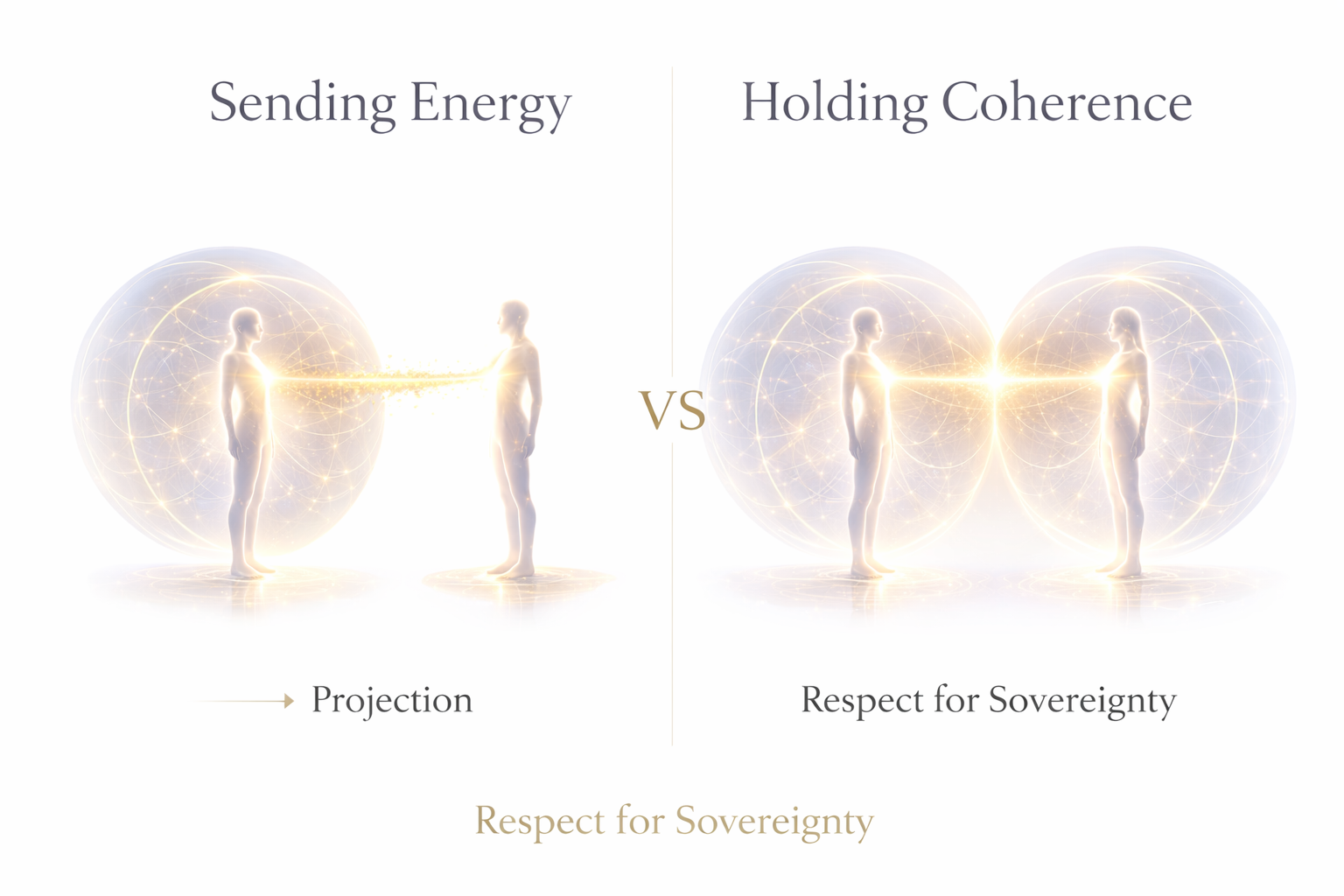
Every person is a sovereign being with their own energetic field, intelligence, and evolutionary process.
When we send energy toward someone without their permission, we are subtly assuming that we know what they need.
Even if the intention is loving.
But true respect for sovereignty means allowing others to navigate their experience in their own way.
Sometimes what someone is moving through is not something to be fixed.
It may be part of their own unfolding, integration, or transformation.
Rather than directing energy toward someone, a different approach is emerging.
One that honors both compassion and sovereignty.
We can hold someone in our awareness.
We can care deeply.
We can remain present.
But instead of sending energy to them, we stabilize our own coherence.
A regulated nervous system.
A calm heart.
A clear field.
When we do this, we contribute stability to the shared field without interfering with another person’s process.
And if someone does ask for support or energy, then the interaction becomes a conscious exchange — one that honors choice and consent.
This subtle shift changes the way we care for one another.
Not by doing more.
But by respecting the intelligence already present in each being.
Compassion remains.
Sovereignty remains.
And the field between us becomes more respectful, spacious, and clear.
Co-Expressing as Sovereign Beings
One of the quiet shifts happening right now is how we relate to one another energetically.
For a long time, many spiritual teachings unintentionally encouraged people to merge fields, fix each other, or take responsibility for the emotional or energetic states of others.
But something more mature is emerging.
A way of being together that honors both connection and sovereignty.
When we co-express as sovereign beings:
We do not collapse into one another’s fields.
We do not try to manage or alter another person’s experience.
We do not carry what is not ours.
Instead, something much more elegant occurs.
Each person stabilizes in their own center — fully present, fully responsible for their own state — and from that stability, interaction becomes clear, spacious, and deeply respectful.
Energy can move between people without entanglement.
Ideas can arise without ownership.
Insight can circulate without hierarchy.
In this kind of field:
Presence replaces control.
Listening replaces projection.
Curiosity replaces reaction.
No one is trying to influence the other.
And yet, something remarkable happens.
When individuals remain sovereign in their own coherence, the shared space between them becomes extraordinarily intelligent.
New ideas appear.
Understanding deepens.
Creative possibilities emerge.
Not because anyone forced them to happen — but because the field between coherent individuals becomes generative.
This is what many of us are beginning to explore in small gatherings, conversations, and collaborations.
Not meetings built around agendas.
But spaces where presence itself becomes the architecture.
Where sovereignty and connection are not opposites —
they are partners.
And from that partnership, something entirely new can emerge.
When Gaia Moves
When Gaia Moves
When the earth shifts — earthquakes, volcanic activity, tectonic unrest — many people instinctively want to “send energy” to calm it.
That impulse comes from care.
From love.
From the desire to help.
And that’s beautiful.
But here’s a perspective that has been quietly maturing for some of us:
The planet is not broken when it moves.
Tectonic activity is not malfunction.
It is regulation.
Gaia is not fragile.
She is dynamic.
There was a time when many of us would focus intensely on areas like the Ring of Fire — sending energy, trying to stabilize, attempting to soften the disturbance.
Over time, something became clear:
When we concentrate on disturbance, we amplify disturbance in our own nervous systems.
And amplified nervous systems do not stabilize fields.
They add energy.
Not because intention is wrong.
But because agitation is contagious.
What if the most supportive posture is not intervention…
but coherence?
Not fixing.
Not correcting.
Not projecting stabilization outward.
But stabilizing here.
The earth does not need rescuing from her own processes.
What she reflects — often — is imbalance within human systems.
So instead of directing force toward tectonic zones, perhaps the invitation is:
Regulate your body.
Stabilize your field.
Live coherently where you stand.
A coherent human nervous system is not passive.
It is stabilizing.
When enough of us hold grounded presence, the planetary field organizes differently — not through force, but through resonance.
This does not mean we ignore suffering.
It does not mean we avoid practical aid.
If support is needed on the ground — we show up materially.
We give.
We respond.
But energetically, the shift is this:
From projecting control
to embodying coherence.
From trying to calm the earth
to becoming calm within it.
The planet is not asking to be managed.
She is asking for mature participants.
And maturity looks like this:
No panic.
No spiritual heroics.
No energetic micromanagement.
Just presence.
And presence is stabilizing.
Gathering with intention vs agendas
Gathering with intention vs agenda
There’s a difference between gathering with an agenda…
and gathering with intention.
An agenda asks:
What are we going to accomplish?
An intention asks:
How are we going to show up?
Agendas organize around outcomes.
Intentions organize around coherence.
For a long time, most gatherings were built around fixing, solving, optimizing, producing.
And there’s nothing wrong with that.
But something new is emerging.
We are learning how to gather as sovereign beings — already whole — not to repair a broken world, but to explore what becomes possible when presence stabilizes first.
No agenda doesn’t mean nothing happens.
It means what happens isn’t forced.
When intention is clear and the nervous systems in the room are regulated, something interesting occurs:
Conversations deepen naturally.
Connections form organically.
Insights arise without pressure.
Collaboration emerges without hierarchy.
Structure still exists.
But it supports coherence rather than directing it.
These new types of gatherings are not passive.
They are precise.
The intention might be:
– to remain present
– to stay open
– to listen deeply
– to allow emergence
From there, what unfolds often exceeds what any agenda could have scripted.
As we shift into new ways of co-expressing in community, we may find that intention creates scalability more sustainably than control ever did.
Because coherence multiplies.
And when coherence is the foundation, contribution becomes joyful — not obligatory.
Maybe the question isn’t:
“What are we going to make happen?”
Maybe it’s:
“What becomes possible when we gather in regulated presence?”
That’s a different kind of architecture.
And it feels like the future.
Gatherings
Why these new types of gatherings matter.
When coherence stabilizes —
when the frequency and the infrastructure beneath it are steady —
something powerful becomes possible.
Scalability.
Not scalability built on urgency, hierarchy, or performance.
But scalability rooted in presence.
Small circles that don’t collapse under distortion
can naturally expand into larger community settings
without losing their integrity.
This is new.
We are learning how to gather
without defaulting to old systems.
Without roles.
Without leaders and followers.
Without agendas that try to fix the world.
No agenda does not mean nothing happens.
It means what happens arises organically.
It means conversations deepen because they want to.
Movement happens because the body feels alive.
Ideas generate because inspiration is present.
Collaboration forms because resonance is natural.
Nothing forced.
Nothing extracted.
Nothing optimized.
Just coherence.
And when coherence is stable,
thriving becomes natural.
We’re not gathering to repair the old system.
We’re gathering to experience what it feels like to live in a new one.
To thrive.
To generate.
To contribute from overflow.
The joy of just being
is not passive.
It is generative.
It creates clarity.
It creates alignment.
It creates new architectures of relationship.
This is how larger community becomes possible.
Not through control.
Through coherence.