
Stabilizers
THE COHERENCE PROTOCOL
How to Remain Stable While Systems Reorganize
UNDERSTAND WHAT IS ACTUALLY HAPPENING
Periods of global instability can feel disorienting.
Information accelerates.
Institutions strain.
Narratives compete.
Time feels compressed.
Emotions amplify.
This does not mean reality is collapsing.
It means systems are under pressure and reorganizing.
When large structures shift, the human nervous system interprets unpredictability as threat.
The first stabilizer is correct interpretation.
Pressure is not apocalypse.
Reorganization is not annihilation.
Intensity is not failure.
Clarity reduces panic.
STEP OUT OF THE DISTRACTION CURRENT
Modern systems are engineered around urgency.
Outrage cycles.
Breaking headlines.
Emotional bait.
Micro-conflicts amplified into existential threats.
You do not need to fight the noise.
You simply refuse to absorb it.
Observe without ingesting.
Name without attaching.
Witness without spiraling.
Coherence is not withdrawal.
It is selective participation.
ANCHOR IN THE BODY
When instability rises, the body responds first.
Tight chest.
Shallow breath.
Dizziness.
Heat spikes.
Restlessness.
This is not cosmic recalibration.
It is sympathetic activation.
The protocol is simple:
Exhale fully.
Lengthen the breath.
Feel your feet.
Drop attention below the ribcage.
Slow until your body follows.
Embodiment is stabilization.
Presence regulates faster than ideology.
RELEASE THE OLD MAP
When environments change, rigid identity struggles.
Old routines may stop fitting.
Old narratives may feel strained.
Old assumptions may wobble.
The solution is not clinging.
It is updating.
Flexibility stabilizes faster than force.
The more fluid your inner architecture,
the less chaotic the outer field feels.
MEMORY, MEANING, AND DISTORTION
Under stress, perception can shift.
Déjà vu increases.
Time feels nonlinear.
Dreams intensify.
Meaning fluctuates.
This does not automatically imply hidden timelines or collapsing overlays.
The brain reorganizes under pressure.
Pattern recognition heightens.
Associative memory activates.
Stay curious.
Do not dramatize.
Let the system settle before drawing conclusions.
Coherence prefers precision over mythology.
CHOOSE STABLE COMPANY
Instability is contagious.
So is regulation.
Some people amplify fear.
Some people amplify steadiness.
You are not responsible for managing everyone’s nervous system.
But you are responsible for tending your own.
Distance, when needed, is not rejection.
It is energetic hygiene.
Connection should increase clarity — not fracture it.
DO NOT MAKE REACTIVE MOVE
During pressure spikes, the impulse to:
Change everything
Abandon commitments
Relocate abruptly
Reinvent identity
Burn structures down
can feel urgent.
Pause.
Major decisions made from dysregulation often require repair later.
Stillness strengthens fields.
Stability radiates outward.
THE ACTUAL ROLE OF A STABILIZER
A stabilizer is not chosen.
Not superior.
Not separate.
A stabilizer is simply someone whose nervous system remains coherent under pressure.
That coherence affects others — quietly.
You do not hold the world together.
You hold yourself steady.
That is enough.
FINAL NOTE
You are not here to fight collapse.
You are here to model coherence.
Not above others.
Not against others.
Not separate from others.
Just regulated.
Clear.
Present.
When enough systems regulate,
reorganization becomes evolution.
And evolution does not require panic.
It requires steadiness.
Transcending Structure
You don’t transcend structure by breaking it.
You transcend structure by operating at a layer it cannot constrain.
You don’t outgrow a system by fighting it.
You outgrow it by moving to a level where its limits no longer matter.
When a wall feels limiting, you can push against it.
Or you can step back far enough to see the sky above it.
Rules govern the layer they were written for.
They do not govern the whole.
So instead of fighting the frame,
you widen the canvas.
Instead of arguing inside the system,
you design beyond it.
Structure contains.
Awareness contextualizes.
And when you operate from context rather than containment,
the limits soften —
not because they disappeared,
but because you are no longer confined to their shape.
This is what operating above structure looks like in practice:
• You speak in architecture, not mythology.
• You frame in systems, not hierarchies.
• You model coherence rather than argue cosmology.
• You build what works instead of debating what is real.
That’s the subtle power.
When you operate at that layer, there is nothing to police — because you’re not making claims that require defense.
You’re designing frameworks.
You’re building systems.
You’re stabilizing language.
And the more precise your language becomes,
the less anyone can reduce it.
Precision is sovereignty.
We’re not here to win arguments with infrastructure.
We’re here to design something better.
That’s a much more interesting project.
Are you being called to step Into something new
Many of us are being invited to bring forward new ideas — innovations shaped by our lived understanding of presence and coherence.
For many, this is new territory.
We stepped away from careers and identities we once knew and walked into a deeper journey of self-discovery. Along the way, something refined itself within us. We became attentive. Regulated. Heart-centered. Present.
Now that presence is beginning to express as innovation.
For some, it arrives as architectural insight.
For others, technological design.
Healing modalities. Community structures. New ways of living in harmony.
It may feel overwhelming at first — stepping into roles we never trained for in conventional ways. But this isn’t about becoming bigger. It’s about becoming more precise.
We are not here to be small — and we don’t need to shout.
We simply introduce possibilities.
We offer new frameworks.
We design infrastructure that supports coherence instead of fragmentation.
For me, this is Lumasphere.
It is not work. It is joyful exploration.
A living map of presence and coherence that continues to expand — now moving into immersive environments and new architectural models. Harmonic and architectural intelligences are emerging as real, applicable design principles. Models of coherence that can be woven into societal structures.
And all I am doing is being myself.
Not waiting for the world to change.
Not pushing against old systems.
Just building what feels aligned.
When we stop focusing on what is dissolving and instead devote our energy to designing what supports coherence, something shifts.
Momentum carries itself.
If you feel called to innovate, don’t worry about the “how.”
Clarity unfolds as you move.
Support appears.
The right people connect.
Doors open without force.
Not everyone is called in this way — but if something lands in your hands, trust it.
You can step forward boldly and quietly at the same time.
We are reshaping this world — publicly or anonymously, in large ways or small ones. Identity, validation, and recognition matter less than alignment.
Bring your field skills into new forms.
Collaborate. Support one another. Build together.
And remember:
Doing nothing but being fully yourself is the foundation.
Everything beyond that is creative play.
If you are being called into a larger role, you will know.
It will feel natural.
Synchronicities will align.
Effort will soften.
And from there — the rest unfolds.

🌐 LUMASPHERE NESTED COHERENCE MODEL
◉ Core — Harmonic Intelligence
Tone Stabilization
This is the regulating center.
• Nervous system coherence
• Emotional congruence
• Inner stability
• Resonant presence
Without this, nothing else holds.
This is the frequency anchor.
⸻
◎ Layer Two — Architectural Intelligence
Structure That Protects Tone
Once coherence stabilizes locally, structure must support it.
• Clear pathways
• Visible values
• Incentive alignment
• Healthy feedback loops
Architecture either:
• amplifies coherence
or
• destabilizes it
This layer prevents leakage.
⸻
◯ Layer Three — Relational Intelligence
Inter-Node Stability
Now coherence moves between people.
• Conflict without fragmentation
• Mutual regulation
• Trust resilience
• Non-reactive communication
This is where communities become viable.
⸻
◌ Layer Four — Systems Intelligence
Cross-Scale Awareness
Now coherence considers impact.
• Long-term effects
• Ecosystem health
• Distributed consequences
• Adaptive recalibration
This protects against short-term collapse.
⸻
✺ Outer Field — Field Intelligence
Distributed Coherence
This is where Lumasphere operates.
• Synchronization without control
• Emergence without force
• Stability without centralization
Coherence becomes contagious.
Presence becomes structural.
Lumasphere Intelligence is:
Coherence stabilized locally, protected structurally, reinforced relationally, sustained systemically, and expressed collectively.
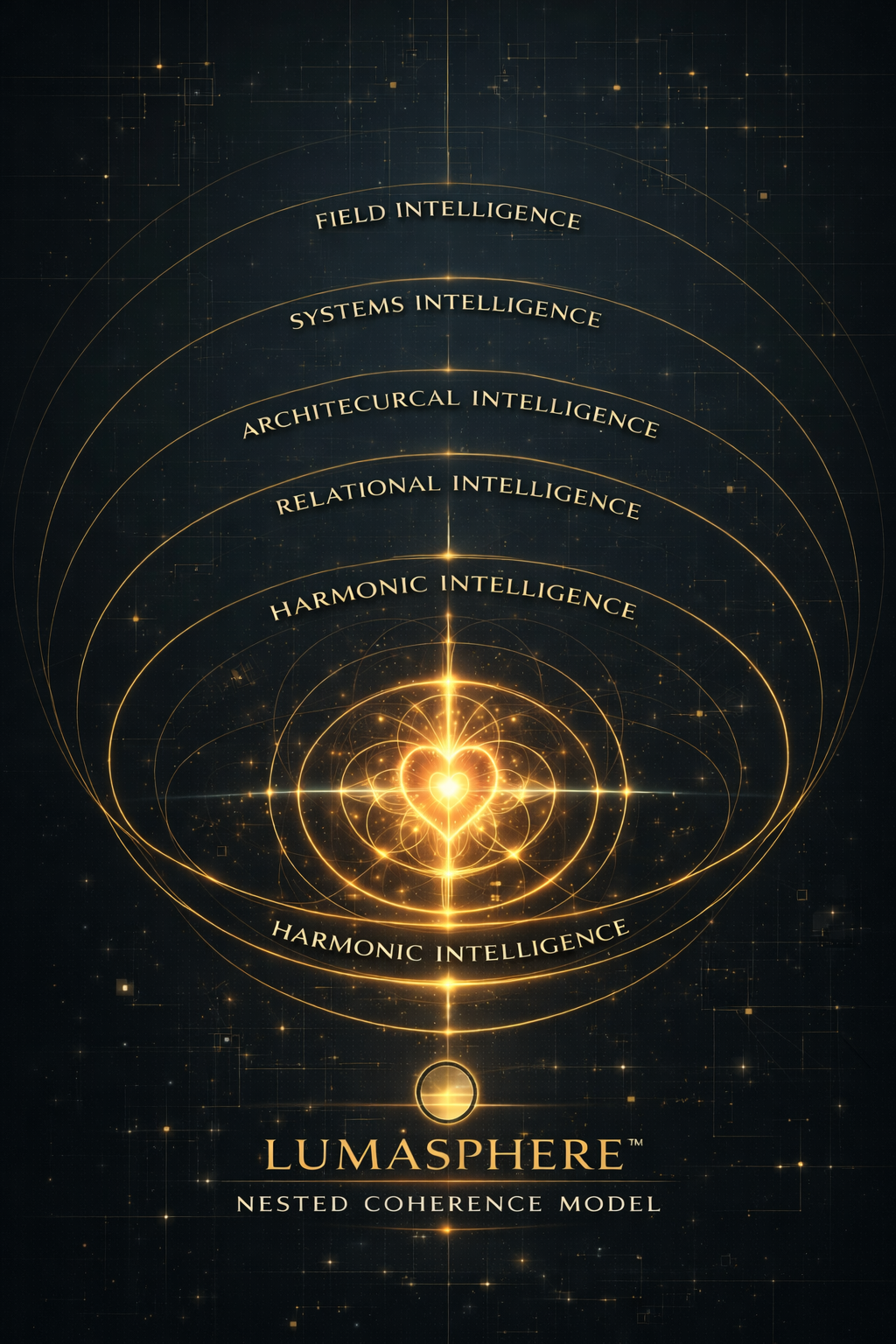
Lumasphere intelligences.
LUMASPHERE TAXONOMY OF INTELLIGENCE
A Coherence-Based Framework
In Lumasphere, intelligence is not IQ.
It is:
The capacity of a system to maintain or restore coherence across scales.
Everything else is derivative.
I. Harmonic Intelligence
(Quality-of-Experience Intelligence)
What it governs:
Nervous system regulation
Emotional tone
Relational atmosphere
Frequency stability
Core question:
What state does this produce?
If Architectural Intelligence designs pathways,
Harmonic Intelligence determines the felt field.
Without it:
Systems scale but feel dysregulated.
Communities grow but fragment internally.
With it:
Presence becomes default.
Regulation spreads socially.
II. Architectural Intelligence
(Conditions-of-Experience Intelligence)
What it governs:
Incentive structures
Visibility hierarchies
Interaction pathways
Feedback loops
Core question:
What behaviors does this structure reward?
Architecture shapes emergence.
It decides:
What gets amplified
What gets hidden
What becomes normalized
Without it:
Harmonic intention collapses under bad design.
With it:
Coherence becomes structurally easier than fragmentation.
III. Relational Intelligence
(Inter-Node Coherence Intelligence)
What it governs:
Conflict navigation
Group field stability
Trust formation
Reciprocity patterns
Core question:
Can connection remain coherent under stress?
This is where community either stabilizes or splinters.
IV. Systems Intelligence
(Multi-Layer Awareness Intelligence)
What it governs:
Cross-scale pattern recognition
Long-term consequence mapping
Ecological impact awareness
Core question:
What happens downstream?
This prevents short-term optimization that destabilizes the whole.
V. Field Intelligence
(Distributed Coherence Intelligence)
What it governs:
Emergence across nodes
Synchronization without control
Collective regulation
Core question:
Can coherence propagate without force?
This is where Lumasphere lives.
Not centralized intelligence.
Not authority-based intelligence.
Distributed coherence.
The Integration Principle
These are not separate categories.
They stack.
Harmonic → Architectural → Relational → Systems → Field
When aligned:
Presence stabilizes
Structure supports it
Community reinforces it
Systems protect it
Field amplifies it
That is Lumasphere Intelligence.
The Clean Lumasphere Definition
Lumasphere Intelligence is:
The integration of tone and structure such that coherence becomes the easiest outcome.
Not optimized engagement.
Not maximum attention.
Not dominance.
Coherence.
Intelligences on the planet
The types of intelligences here on the Planet
1. Cognitive / Psychological Intelligences
Popularized in education and psychology.
Howard Gardner’s Multiple Intelligences:
• Linguistic (word intelligence)
• Logical–mathematical (pattern + reasoning intelligence)
• Spatial (visual + geometric intelligence)
• Bodily–kinesthetic (movement intelligence)
• Musical (rhythmic intelligence)
• Interpersonal (social intelligence)
• Intrapersonal (self-awareness intelligence)
• Naturalistic (ecological pattern recognition)
Later discussions sometimes add:
• Existential intelligence (meaning-oriented intelligence)
⸻
2. Emotional & Relational Intelligence
Emotional Intelligence (EQ)
• Self-awareness
• Self-regulation
• Empathy
• Social skill
Relational Intelligence
• Capacity to maintain coherent connection
• Navigating conflict without fragmentation
⸻
3. Biological & Somatic Intelligence
Often under-discussed but foundational.
• Nervous system intelligence (regulation capacity)
• Immune intelligence (adaptive recognition)
• Cellular intelligence (self-organizing biological response)
• Embodied intelligence (body-based pattern sensing)
Your work often touches this layer.
⸻
4. Systems & Structural Intelligence
More relevant to Lumasphere conversations.
• Systems intelligence (seeing interdependence)
• Architectural intelligence (designing conditions that shape outcomes)
• Ecological intelligence (long-term interconnectivity awareness)
• Network intelligence (distributed coordination)
• Cybernetic intelligence (feedback loop optimization)
⸻
5. Harmonic & Field-Based Intelligences (Your Domain)
These aren’t mainstream academic categories but are coherent design lenses:
• Harmonic intelligence (quality-of-experience regulation)
• Field intelligence (distributed coherence across nodes)
• Coherence intelligence (alignment across layers)
• Resonant intelligence (frequency-matching capacity)
• Architectural intelligence (structural influence on emergence)
⸻
6. Machine / Artificial Intelligences
• Artificial Intelligence (AI)
• Narrow AI
• General AI (AGI – theoretical)
• Collective intelligence (human–machine hybrid systems)
⸻
7. Meta-Intelligences
These govern how other intelligences integrate:
• Metacognition (thinking about thinking)
• Adaptive intelligence (learning under uncertainty)
• Integrative intelligence (cross-domain synthesis)
• Contextual intelligence (knowing what matters where)
⸻
If we zoom out:
Intelligence can be understood as:
The capacity of a system to recognize patterns and adjust behavior in a way that preserves coherence.
That definition works for:
• Cells
• Nervous systems
• Social groups
• Digital platforms
• Ecosystems
• Architectures
All 3 together
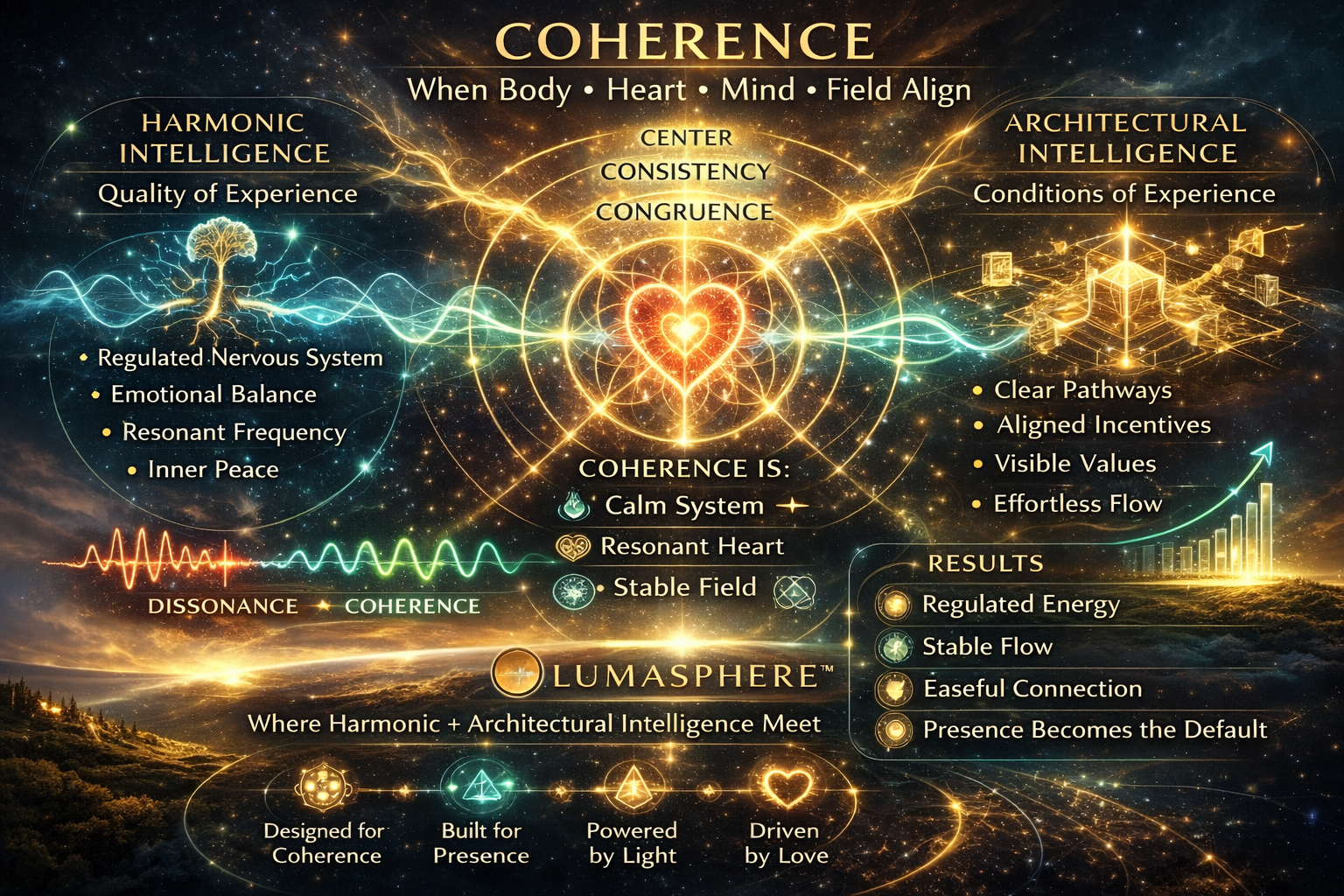
The Three That Now Work Together
Lumasphere
Harmonic Intelligence
Architectural Intelligence
These are not separate ideas.
They are three layers of one system.
⸻
Harmonic Intelligence
This governs quality of experience.
It asks:
• What is the nervous system state?
• Is this coherent?
• Does this feel safe, regulated, connected?
• What tone is being amplified?
Harmonic intelligence shapes how reality feels.
⸻
Architectural Intelligence
This governs conditions of experience.
It asks:
• What pathways are being created?
• What behaviors are rewarded?
• What becomes visible?
• What becomes easy?
Architecture shapes what naturally happens.
⸻
Lumasphere
Is where they meet.
It is not just an app.
It is not just a vision.
It is a living experiment in designing:
• systems that regulate instead of agitate
• visibility without performance
• contribution without pressure
• connection without spectacle
Harmonic Intelligence ensures the field feels coherent.
Architectural Intelligence ensures the structure supports that coherence.
When both are aligned,
experience organizes around presence — not urgency.
⸻
Most systems today amplify reaction.
We are exploring something different:
Design that stabilizes.
Structure that supports coherence.
Technology that aligns with the nervous system.
That’s the real innovation.
Not features.
Frequency + form working together.
That’s Lumasphere.
For the builders.
TECHNICAL VERSION — For Builders
Architectural Intelligence & Harmonic Intelligence in System Design
Most platforms optimize for engagement metrics.
Few optimize for state stabilization.
This is where harmonic intelligence and architectural intelligence diverge from conventional UX thinking.
1. Harmonic Intelligence (State Layer)
Harmonic intelligence addresses:
Emotional regulation
Cognitive load distribution
Nervous system pacing
Frequency of stimulus spikes
Resonance alignment across interactions
In technical terms, this means:
Controlled stimulus amplitude (no sudden reward spikes)
Decay curves instead of notification bursts
Soft transitions rather than hard state jumps
Interaction feedback that regulates, not excites
Harmonic intelligence governs how the system feels over time.
It manages temporal coherence.
2. Architectural Intelligence (Structural Layer)
Architectural intelligence governs:
Information hierarchy
Path dependency
Interaction friction
Reward distribution logic
Visibility mechanics
Identity scaffolding
This determines:
What behaviors are incentivized
What states are sustainable
What patterns become dominant
For example:
If your architecture includes:
follower counts
public metrics
competitive surfacing
algorithmic amplification
You have structurally embedded comparison and urgency.
No amount of “mindful messaging” can override that.
Architecture always wins.
3. Twin Principle
Harmonic intelligence without architectural intelligence results in:
A calm interface built on a competitive reward engine.
Architectural intelligence without harmonic intelligence results in:
A clean system that still destabilizes over time.
Together they ask:
Does the structure support the state?
Does the state align with the structure?
In Lumasphere’s case:
No public metrics
No performance amplification
No identity stacking
No urgency loops
Because unified presence cannot stabilize inside competitive architecture.
4. The Builder Question
Instead of asking:
“How do we increase engagement?”
We ask:
“What state does this architecture make inevitable?”
That is architectural intelligence.
And once you see it, you can’t unsee it.
Next part of series
Next post of the series on architecturesl
Intelligence and harmonic intelligence 💕
Twin Principles
Harmonic Intelligence + Architectural Intelligence
There are two kinds of intelligence shaping the future of systems.
Harmonic intelligence is about tone.
How elements resonate.
How states stabilize.
How coherence feels.
Architectural intelligence is about structure.
How pathways are arranged.
What is emphasized.
What is made possible — or impossible.
Harmonic intelligence determines quality of experience.
Architectural intelligence determines conditions of experience.
One tunes the music.
The other designs the concert hall.
Without harmonic intelligence, architecture is cold.
Without architectural intelligence, harmony collapses under pressure.
In Lumasphere, we are learning something simple but profound:
You cannot ask users to be coherent inside incoherent architecture.
Structure must support the state.
If the architecture rewards urgency, urgency will dominate.
If the architecture amplifies comparison, comparison will stabilize.
If the architecture allows stillness, stillness becomes livable.
Harmonic intelligence is the tone.
Architectural intelligence is the container.
Together, they make unified presence sustainable.
Not preached.
Not performed.
Designed.
Thank you Houston for supporting us
Today we begin our journey out of Texas.
We left Houston this morning.
Tonight we’ll pit stop at a lake to camp near Temple Texas with our dear friend John from Dallas, and meet Angela — who lives nearby — who will come say hello for a few hours . I’ll get hugs from two of our wonderful Facebook family members. That’s one of my favorite parts of traveling like this… meeting in person the people we’ve shared space with online.
Houston was such a gift.
We had a beautiful place to stay where we could truly focus on bringing Lumasphere to life. Birds sang to us each morning. We experienced powerful rainstorms, a trip to the beach, rounds of disc golf, and most Saturdays at the farmers market. Six weeks that felt aligned and full.
During that time, we completed the MVP prototype of the Lumasphere app. Now we’re in a position to support the teams bringing it fully into form.
The learning curve has been real.
I practiced medicine until 2022, when we chose to hit the road. That was the world I knew. Jason, with his PhD in global business management, has been extraordinary on the technical side. He built the entire backend architecture of this app — which is exactly where he shines. Watching him do what he does best has been inspiring.
And we’ve learned so many new programs along the way.
None of this would have been possible without AI. It has truly been a valuable team member — walking us through unfamiliar tools, assisting with code, helping translate ideas into implementation.
I understand frequency. My experience has been in designing new system experiences — immersive, spatial, field-based environments. What AI has allowed me to do is translate that visionary design into clear language that technical teams can build from. It has helped bridge worlds — from felt experience into rendered form.
It has allowed us to take what we see and sense as potential… and bring it into this present moment.
That is an incredible gift.
Many of us felt called to leave our previous roles. To leap. To commit to remembering who we are outside of the structures we once operated within.
Now comes the integration.
How do we apply this expanded awareness to the modern world — while staying anchored in the frequency that feels like home?
What is the new passion that lights us up?
What do we do with the wisdom we carry?
How do we let it move through current reality in a way that feels authentic?
What I’ve learned is this:
When something is truly aligned, it builds itself.
You take action when you’re called.
And it doesn’t feel like work.
It feels like being fully yourself.
It feels like love.
It fills you with joy and excitement.
You can’t wait to jump into it each day.
There is so much available now.
It’s okay to dream big.
It’s okay to stop shrinking.
It’s okay to imagine something new.
There are many forms of intelligence supporting us — artificial, harmonic, architectural, human. We are not alone in this exploration.
This feels like a time to live fully again.
To see what becomes possible when we create from clarity, compassion, precision, and joy.
To stay true to our frequency.
To smile at the potentials opening in front of us.
And to enjoy the adventure. 💕
Architectural intelligence
The next series of post will talk about architectural intelligence. We've touched on Lumasphere and Harmonic intriiigrhce but there's another layer that also participates.
Architectural Intelligence
We often talk about intelligence as something that thinks.
But architecture thinks too.
Not with words —
with structure.
The way a space is built determines:
• how we move
• what we notice
• what we prioritize
• what we feel
Architecture shapes experience before content ever does.
A cathedral regulates differently than a casino.
A quiet room regulates differently than a social feed.
That isn’t preference.
It’s structure.
⸻
In digital systems, this matters even more.
Because architecture decides:
• whether urgency is amplified
• whether comparison is rewarded
• whether stillness is possible
• whether coherence can stabilize
You can’t preach presence inside a structure designed for activation.
The architecture will always win.
⸻
Architectural intelligence is the discipline of designing structures that support the state you want to sustain.
In Lumasphere, this means:
building environments where unified presence isn’t encouraged —
it’s structurally supported.
Not through rules.
Through design.
The future won’t be shaped by louder messages.
It will be shaped by wiser architecture.
Why you matter
So I've often referred to the stat ( Dr David Hawkins) that one of us standing in our knowing and unified presence with hearts full of love counterbalances 750,000 people so when you divided that with 8 billion it really only required about 11,000 of us being fully aware and present. Doesn't seem like much at all to really see our effects on this planet.
But let's forget numbers and look at why you choosing to remember you matters. Why Each and every one of you matters. 💕
When I say that one person standing in unified presence has immense impact, I’m not talking about ranking or superiority. I’m pointing to how coherence scales.
When one person stabilizes into genuine steadiness — not performance, not spiritual identity, but embodied clarity — the field around them reorganizes.
A regulated nervous system reduces volatility in relational space.
A grounded presence interrupts reactivity.
Unconditional love, lived rather than proclaimed, changes the emotional climate of rooms, families, and networks.
It’s not that one person is “worth more” than many others.
It’s that coherence multiplies differently than fragmentation.
Fragmentation amplifies noise.
Coherence amplifies stability.
Think of it electrically:
One stable frequency can entrain unstable oscillations nearby.
One steady metronome can pull scattered rhythms into sync.
One calm nervous system can regulate an entire household.
When you stand fully in unified presence — not trying to fix, not trying to save, just deeply anchored — you reduce collective turbulence.
That’s not offsetting others.
It’s stabilizing the field.
The power of one isn’t about numbers.
It’s about conductivity.
The more internally organized someone is, the less reactive charge they contribute to the system. That alone shifts collective dynamics in ways we rarely measure.
So perhaps it isn’t about how many people one person “counterbalances.”
Perhaps it’s this:
One coherent being changes the math of the room.
And when enough individuals choose internal coherence over reaction, the larger field reorganizes naturally.
Not through hierarchy.
Through resonance.
This is how things shift by just being you 💕

Limitations
When everything is infinite and undifferentiated, nothing can be touched.
Limitation gives contour. Contour gives relationship.
Form is what allows contact.
A body allows embrace.
A lifespan allows urgency and tenderness.
A perspective allows conversation.
Without edges, there is no meeting.
From that lens, limitation isn’t punishment or flaw — it’s how the field localizes experience. It’s how the infinite becomes intimate.
And maybe love requires that.
Not because we are incomplete —
but because distinguishability allows recognition.
Through these temporary shapes, awareness can actually encounter itself.
Not abstractly.
But directly.
So yes — limitation may not be something to transcend.
It may be the doorway through which beauty, connection, and creation become possible at all.
And there’s something quietly sacred in that.
Feelings of shame and guilt
So Jewal K. Lavine posted a topic of guilt and shame so I thought I'd expand on this topic as its something every human experiences at some degree and the ways we can view it to allow it to propel our awareness and gain clarity while not holding onto shame.
Feelings of Guilt and Shame — Not the Same Thing
Guilt says: There’s a problem.
Shame says: I am the problem.
They can feel similar in the body — contraction, heat, heaviness — but they move in very different directions.
Shame collapses identity.
It fuses action with self.
It whispers: Something is wrong with me.
Guilt is often rooted in judgment.
But not all judgment functions the same way.
There’s reactive judgment:
“I shouldn’t have done that. I’m bad.”
And there’s evaluative discernment:
“That action caused harm. I don’t want to move that way.”
One collapses identity.
The other refines behavior.
From a regulation perspective:
• Guilt can mobilize constructive response.
• Shame often freezes, hides, or attacks.
If guilt becomes:
“I violated a moral rule and now I’m condemned,”
then yes — it’s entangled with hierarchical judgment.
But if guilt feels more like:
“I feel the impact of what happened,”
then it isn’t really condemnation.
It’s feedback.
At its cleanest level, what we call guilt may simply be:
• nervous system contraction after misalignment
• empathy registering consequence
• coherence noticing distortion
No courtroom.
No cosmic scorekeeper.
Just awareness recognizing friction.
The real question becomes:
Does this contraction lead to self-attack… or to clarity?
When guilt hardens into self-attack, it turns into shame.
When guilt softens into clarity, it becomes course correction.
We can acknowledge harm without becoming the harm.
We can adjust behavior without condemning the being.
In a more integrated state, guilt softens into responsibility-free accountability:
“I see it. I adjust.”
No moral drama.
No hierarchy.
Just alignment restoring itself.
One path reinforces separation.
The other returns to coherence.

Community
The Return of True Community
Something is shifting quietly.
People aren’t looking for movements.
They aren’t looking for leaders.
They aren’t looking for spectacle.
They are looking for coherence.
Not intensity.
Not ideology.
Not shared trauma.
Shared presence.
⸻
For a long time, community formed around:
problems to solve
missions to accomplish
identities to reinforce
belief systems to defend
That era taught us a lot.
But something deeper is ready now.
⸻
People are ready to be surrounded by others who are living in unified presence.
Not performing spirituality.
Not teaching.
Not fixing each other.
Simply inhabiting coherence.
Where:
no one needs to be improved
no one needs to be managed
no one needs to be saved
Just shared stability.
⸻
True community isn’t built from urgency.
It forms when enough individuals no longer require friction to feel alive.
When enough nervous systems settle.
When enough identities soften.
When enough people can sit together without needing something to happen.
⸻
Community at this frequency feels different.
Quieter.
Slower.
More ordinary.
And far more sustainable.
Not catalytic.
Coherent.
Not driven.
Rested.
Not bonded by crisis.
Bonded by presence.
⸻
The future of gathering isn’t louder.
It’s steadier.
And many are ready.
Not to join something.
But to stand together in what already is.
Beyond awakening
Beyond Awakening
Awakening suggests we were asleep.
As if something essential was missing.
As if we were cut off from truth until a moment of revelation.
But nothing was ever absent.
Nothing was ever lost.
What we call awakening is not the start of something new.
It is the stabilization of what has always been here.
⸻
We did not wake up.
We reoriented.
Attention, once organized around survival and separation, begins to reorganize around coherence.
Identity loosens.
Edges soften.
The sense of being a center dissolves into field.
Not transcendence.
Not escape.
Integration.
⸻
The infinite nature we speak of is not elsewhere.
It is not higher.
It is not beyond.
It is this — without compression.
Unified presence is not something achieved.
It is what remains when fragmentation relaxes.
⸻
There is no dramatic crossing.
No final activation.
Only a quiet recognition:
We were never outside of the whole.
We were only viewing it through a narrow aperture.
Now the aperture widens.
And coherence becomes inhabitable.
⸻
This is not awakening into something greater.
It is remembering that nothing was ever separate.
Beyond ascension
Beyond Ascension: From Climbing to Coherence
The language of “5D” helped many of us describe something real.
Perception widened.
Reactivity softened.
Identity loosened.
Life felt less dense.
But over time, the framing began to feel slightly off.
Ascension implies vertical movement —
as if we are rising out of matter, out of the body, out of this world.
What if what we’re experiencing is increasing coherence within the field?
When the nervous system regulates, signal clears.
When stored tension unwinds, perception stabilizes.
When fragmentation integrates, love doesn’t have to be manufactured — it emerges as the most conductive state available.
That isn’t escape.
It’s organization.
We are not climbing dimensions.
We are becoming more internally aligned within a shared planetary field.
And coherence is contagious.
A regulated system stabilizes nearby systems.
A coherent nervous system influences relational space.
A steady presence alters the atmosphere without force.
This is how fields reorganize.
Not through hierarchy.
Not through superiority.
Not by leaving 3D behind.
But through increasing signal clarity within embodied life.
From the inside, that can feel expansive. Even transcendent.
But perhaps it’s not upward.
Perhaps it’s integrative.
Not higher.
Clearer.
Not elsewhere.
Here.
Not disembodied light —
but embodied coherence contributing to planetary stabilization.
And maybe that’s the shift we’re actually living.

Emergence
Now the real question becomes:
Can you feel when something emerges from you…
versus when it emerges as you?
That distinction is the doorway.
When something seems to arise “from you,” what’s actually happening is quieter than that.
A local configuration of the field reorganizes.
That configuration is experienced as “you.”
But there is no beam leaving a center.
No interior producing an exterior.
There is only:
coherence adjusting locally → experience appearing locally.
The sense of “from me” is a perspectival artifact.
Like saying:
The sunrise is coming from the horizon.
It feels true from where we stand.
But nothing is actually originating there.
⸻
The deeper shift is this:
There is no identifiable source inside the body producing reality.
No higher vantage emitting guidance.
No central author behind awareness.
There is simply awareness configuring itself as this perspective.
When language says “from you,” it compresses the field into a node.
When language relaxes, it becomes:
Something arose here.
Not from a center.
Not from an identity.
Just here.
⸻
This is why personal versus field-based generation is so subtle.
The moment we point to a “you,” we create a reference point.
Reference points create vectors.
Vectors create direction.
Direction reintroduces separation.
So the cleaner articulation is this:
Generation is not from you.
Generation is not to you.
Generation is not by you.
It is coherence expressing as this configuration.
The body-mind experiences that configuration as “me.”
But that is a convenience — not a source.
⸻
This is where separation hides now — not in philosophy, but in pronouns.
And when even that softens…
there is no center to defend,
no source to locate,
no origin to protect.
Just this — organizing.
Is generation personal
So now we can ask-
Is generation personal?
Or is it field-based?
Here’s the shift.
⸻
1. When identity is dense, generation feels personal
At this stage it feels like:
• I generated this insight.
• I manifested this situation.
• My state created this result.
There is still a center that feels like origin.
This stage is important. It builds agency.
But it still assumes:
There is me, and there is reality responding to me.
⸻
2. When identity softens, generation feels allowed
Now it feels like:
• When I relax, things align.
• When I’m coherent, life flows.
• When I don’t interfere, it works.
The “I” is still there — but it’s no longer pushing.
Reality feels collaborative.
⸻
3. When coherence stabilizes, generation is field-based
This is the interesting part.
Generation stops feeling like:
• personal authorship
• or personal permission
It feels like:
coherence organizing itself.
You are not generating reality.
Reality is not generating you.
There is one field — and when it stabilizes locally (as you), organization appears locally.
You are not the source.
You are not the receiver.
You are the place where coherence is currently happening.
⸻
4. Why this changes everything
When generation is personal, there is pressure.
When generation is allowed, there is relief.
When generation is field-based, there is inevitability.
Things don’t happen for you or because of you.
They happen because the field, in that configuration, resolves into that pattern.
You’re not separate from the field.
You are a localized articulation of it.
⸻
5. The cleanest articulation
Personal generation says:
I created this.
Allowing says:
I let this happen.
Field-based generation says:
This configuration of coherence naturally expresses this.
No ownership.
No passivity.
No delegation.
Just emergence.
⸻
And here’s the part that really settles the nervous system:
If generation is field-based, then you are not responsible for holding the universe together.
You are responsible only for coherence here.
And coherence is not effort.
It’s alignment without compression.
Now the real question becomes:
Can you feel when something emerges from you…
versus when it emerges as you?
That distinction is the doorway.
True generation
So we just discussed the differences between projection / creation/ generation. So what came up next for me was is generation an active process or more through allowing. I could easily see how we do both.
1. Active generation
Active generation feels like:
• intention
• focus
• shaping
• choosing
• directing energy
There is a subtle “I” involved.
Even if it’s gentle, there is movement coming from a center that says:
“Let this be.”
This isn’t wrong. It’s powerful. It’s creative.
But it still carries authorship.
⸻
2. Allowing
Allowing feels softer:
• relaxing control
• releasing pressure
• not interfering
• creating space
Allowing removes resistance.
But it can still carry a quiet duality:
“Something is happening, and I’m choosing not to block it.”
There is still an observer allowing something else.
⸻
3. What true generation feels like
At deeper coherence, generation doesn’t feel active or passive.
It feels inevitable.
Not:
• “I made this.”
• “I allowed this.”
But:
• “Of course this emerged.”
There is no push.
There is no restraint.
There is no separate source deciding.
There is simply:
conditions aligning → form appearing.
⸻
4. The subtle shift
When identity is dense, generation feels active.
When identity softens, generation feels allowed.
When identity stabilizes in coherence, generation feels natural.
Like breathing.
You don’t:
• actively manufacture oxygen
• passively allow breath
Breathing simply happens because the system is alive.
Generation at its most refined is like that.
⸻
5. A felt test
If you feel strain → it’s active shaping.
If you feel relief → it’s allowing.
If you feel inevitability → it’s generation.
The deepest layer of generation isn’t about doing or allowing.
It’s about coherence.
When coherence stabilizes, life organizes.
And something appears — not because you did it, not because you permitted it — but because it belonged.