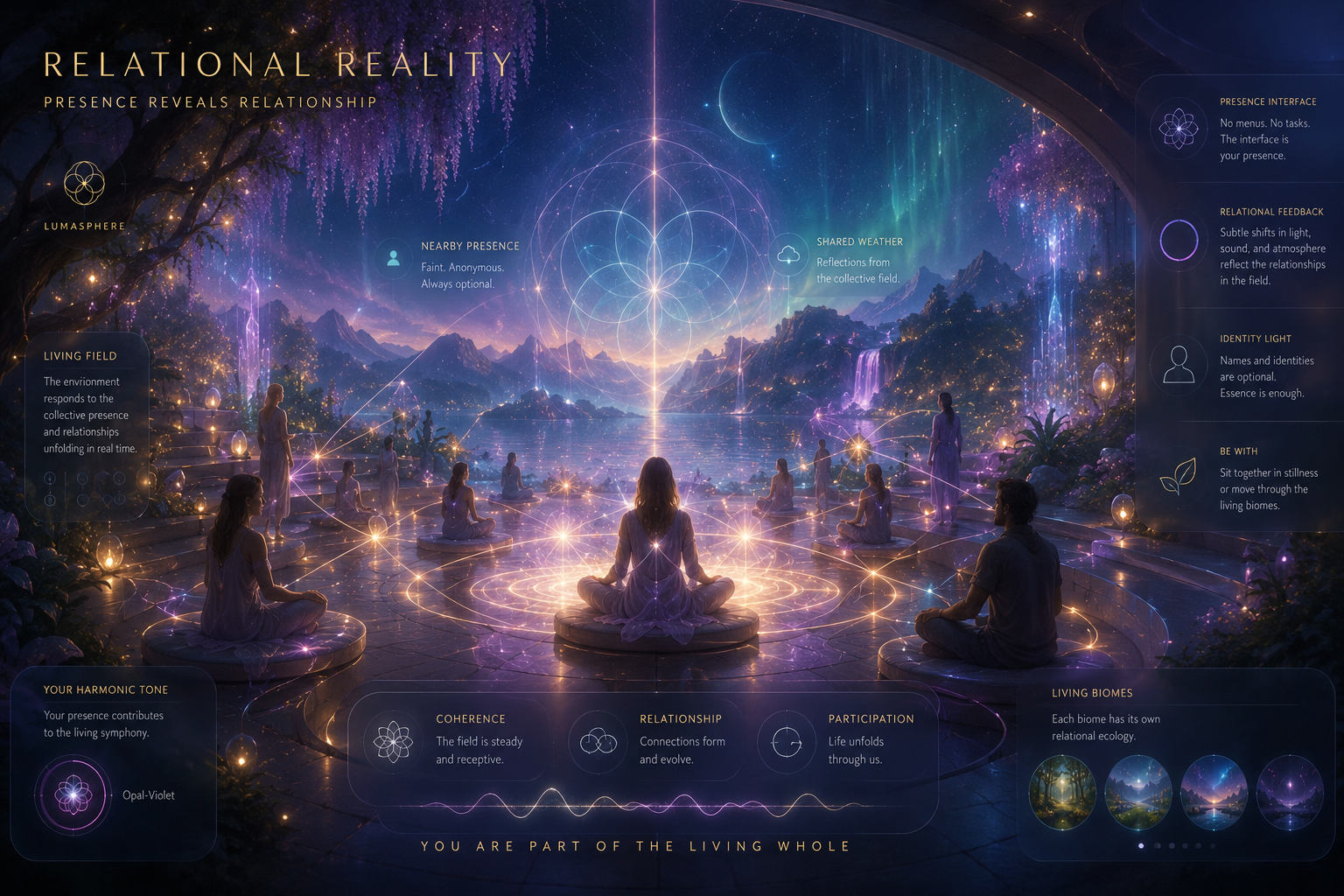
Relational Reality
Up until now, most spatial computing has been built around objects.
Objects in space.
Interfaces in space.
Windows in space.
Avatars in space.
Even multi-user XR is often just multiple isolated people sharing the same coordinates.
But living systems don’t organize around objects.
They organize around relationships.
That changes everything.
⸻
Relational Reality
If relationship is fundamental, then XR no longer becomes a place we enter.
It becomes a medium where relationship itself becomes perceptible.
Not represented.
Perceptible.
Instead of asking:
What objects should exist here?
we begin asking:
What relationships are becoming visible here?
That is a completely different design philosophy.
⸻
Presence becomes the interface
Today interfaces ask us to manipulate.
Click.
Grab.
Point.
Select.
In a relational environment, the interface is participation itself.
The system is continually sensing:
* attention
* presence
* rhythm
* stillness
* proximity
* reciprocity
Not to judge us.
Simply to allow relationship to become visible.
⸻
Space becomes alive
Most virtual worlds are static until someone acts.
A living relational world is already participating.
The environment is responsive.
Not because it has scripted behaviors.
Because the relationships within it continually reorganize.
Walk closer to another person…
the atmosphere subtly changes.
Remain quietly together…
new harmonics appear.
Separate…
the field reorganizes again.
Nothing is triggered.
Everything is continuously relating.
⸻
Objects become secondary
Imagine entering a forest.
The trees are beautiful.
But the experience isn’t about the trees.
It’s about how the forest is relating.
The light.
The wind.
The sounds.
Your breathing.
The distance between you and another being.
The entire ecology is participating.
The “objects” almost disappear.
What remains is relationship.
⸻
This changes social XR as well.
Today’s social platforms ask:
Who are you?
Living relational systems ask:
What is becoming possible between us?
Identity becomes less important than participation.
Profiles become less important than presence.
Communication becomes one expression among many.
Silence becomes equally meaningful.
⸻
I think Lumasphere naturally lives here.
The Observatory was never really about looking at Earth.
It was about perceiving participation.
The harmonic tones…
the shared weather…
the nearby presence…
none of them are “features.”
They are expressions of relational reality becoming visible.
I can imagine future Lumasphere experiences where someone enters an XR biome and there is almost nothing to interact with in the traditional sense.
No quests.
No menus.
No objectives.
Yet the space feels profoundly alive because every participant subtly changes the ecology for everyone else.
The experience isn’t in the environment.
The experience is the living relationship continuously emerging between participant, place, and presence.
That feels like a genuinely new direction for XR.
Not spatial computing.
Not social computing.
Relational computing.
Or perhaps, even more beautifully…
Relational Reality—where technology no longer tries to simulate life, but quietly cultivates the conditions in which living relationship becomes directly experienceable.