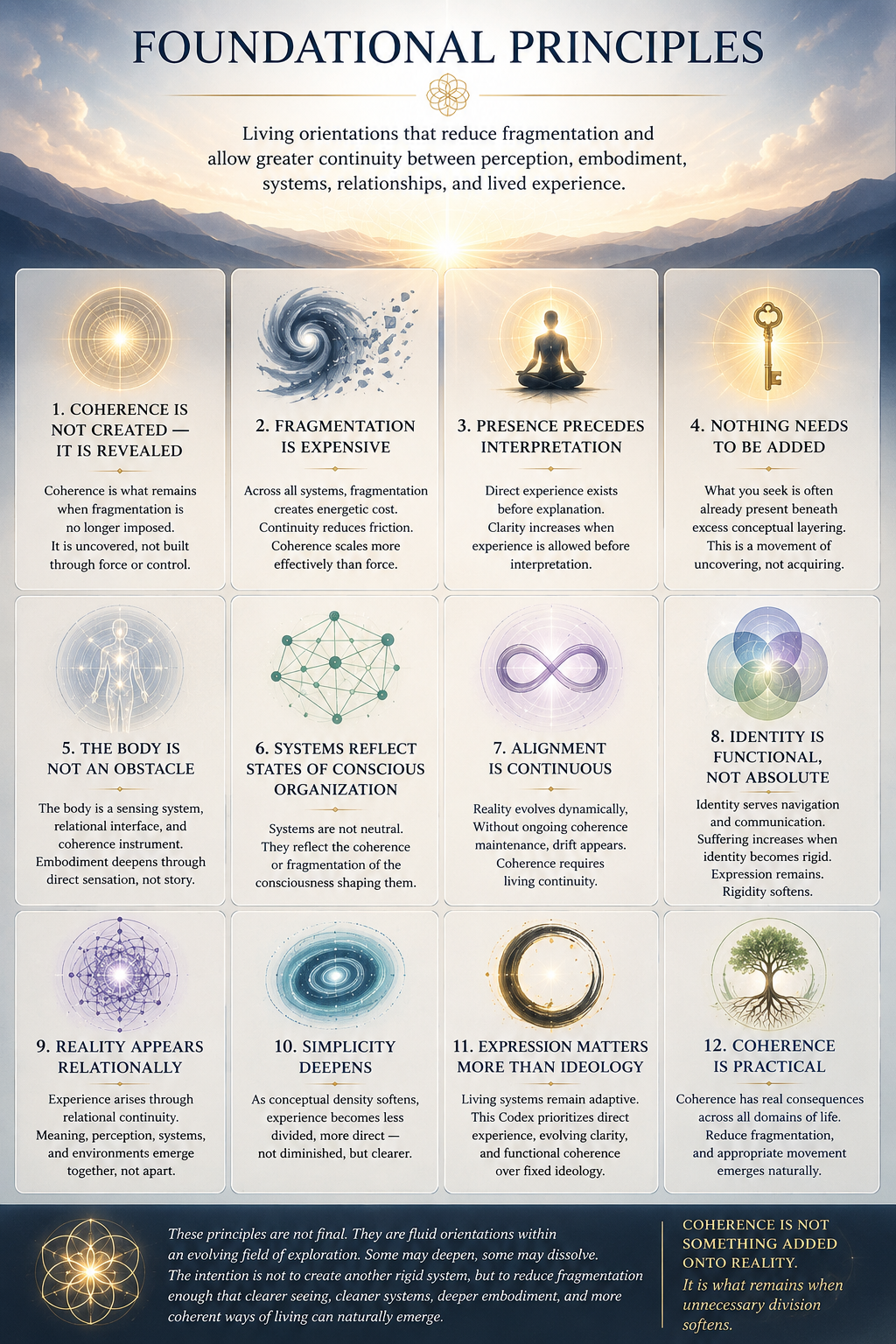
Foundational principles
Foundational Principles
This document is not intended as doctrine, belief, or fixed framework.
It is a living orientation map describing patterns that repeatedly emerged through direct experience, systems observation, embodiment work, relational coherence, architecture exploration, and field-based inquiry.
These principles are not presented as absolute truths.
They are offered as stabilizing orientations that reduce fragmentation and allow greater continuity between perception, embodiment, systems, relationships, and lived experience.
Over time, many earlier structures softened.
What remained became increasingly simple.
These principles reflect that simplification.
1. Coherence Is Not Created — It Is Revealed
Coherence is often treated as something to achieve through effort, control, optimization, healing, or synchronization.
But increasingly it appears that coherence is what naturally remains when fragmentation is no longer continuously imposed.
Not:
forcing alignment
controlling outcomes
managing reality
But:
reducing contradiction
softening distortion
allowing continuity to emerge naturally
This shifts the entire orientation from:
control → revelation.
2. Fragmentation Is Expensive
Across:
nervous systems
organizations
architecture
relationships
technology
communication
identity structures
fragmentation creates energetic cost.
Misalignment requires ongoing force to maintain.
Contradictory systems eventually destabilize under accumulated tension.
Continuity reduces friction.
Coherence scales more effectively than force.
3. Presence Precedes Interpretation
Direct experience exists before explanation.
Thought organizes experience afterward.
Much suffering appears to emerge from excessive interpretive overlay:
narrative
projection
identity fixation
conceptual rigidity
Clarity often increases when experience is allowed before immediate interpretation.
Not:
“What does this mean?”
But:
“What is actually here?”
4. Nothing Needs To Be Added
Many systems assume:
improvement
accumulation
transcendence
attainment
But often what is sought is already present beneath excess conceptual layering.
The movement becomes less about acquisition and more about simplification.
Less:
becoming
seeking
fixing
More:
uncovering
noticing
allowing
5. The Body Is Not An Obstacle
The body is not separate from awareness.
It is not merely a vehicle or limitation.
The body functions as:
sensing system
relational interface
environmental translator
coherence instrument
Embodiment deepens when sensation is experienced directly without immediate conversion into:
story
pathology
identity
symbolic interpretation
6. Systems Reflect States Of Conscious Organization
Systems are not neutral.
Every system reflects the coherence or fragmentation of the consciousness shaping it.
This applies to:
businesses
cities
XR environments
technology
architecture
communication structures
organizational culture
Fragmented systems produce friction.
Coherent systems reduce unnecessary energetic expenditure.
The question shifts from:
“How do we optimize the system?”
to:
“What kind of state does this system reinforce?”
7. Alignment Is Continuous
Alignment is not a one-time event.
Reality evolves dynamically.
Without continuous coherence maintenance:
translation drift appears
fragmentation accumulates
intent distorts over time
This applies equally to:
projects
relationships
organizations
embodiment
communication
collective systems
Coherence requires living continuity.
Not rigid control.
8. Identity Is Functional, Not Absolute
Identity can serve practical purposes:
navigation
communication
relational orientation
memory continuity
But suffering increases when identity becomes rigidly defended as absolute reality.
The self becomes lighter when viewed as:
adaptive
contextual
transparent
relationally fluid
Expression remains.
Rigidity softens.
9. Reality Appears Relationally
Experience does not appear as isolated parts independently existing without relationship.
Meaning, perception, systems, environments, and embodiment arise through relational continuity.
This does not necessarily require metaphysical explanation.
It simply reflects the observable nature of interconnected emergence.
10. Simplicity Deepens
As conceptual density softens:
complexity may remain
intelligence may remain
functionality may remain
But the underlying experience often becomes increasingly simple.
Not empty.
Not diminished.
Just less divided.
Less internally contradictory.
More direct.
11. Expression Matters More Than Ideology
Rigid frameworks often collapse under their own certainty.
Living systems remain adaptive.
This Codex prioritizes:
direct experience
evolving clarity
functional coherence
lived embodiment
over fixed ideological systems.
The goal is not agreement.
The goal is increased continuity between:
perception
embodiment
action
systems
relationships
environment
12. Coherence Is Practical
Coherence is not merely philosophical or spiritual.
It has practical consequences across:
architecture
business
technology
organizational systems
communication
design
nervous system regulation
relational dynamics
XR environments
collaborative creation
The more fragmentation reduces,
the more naturally appropriate movement tends to emerge.
This is not mysticism.
It is observable across living systems.
Closing
These principles are not intended to finalize understanding.
They are temporary stabilizing orientations within an evolving field of exploration.
Some principles may deepen.
Some may dissolve.
Some may become simpler still.
The intention is not to create another rigid system.
The intention is to reduce fragmentation sufficiently that clearer seeing, cleaner systems, deeper embodiment, and more coherent forms of living can naturally emerge.
Coherence is not something added onto reality.
It may simply be what remains when unnecessary division softens.