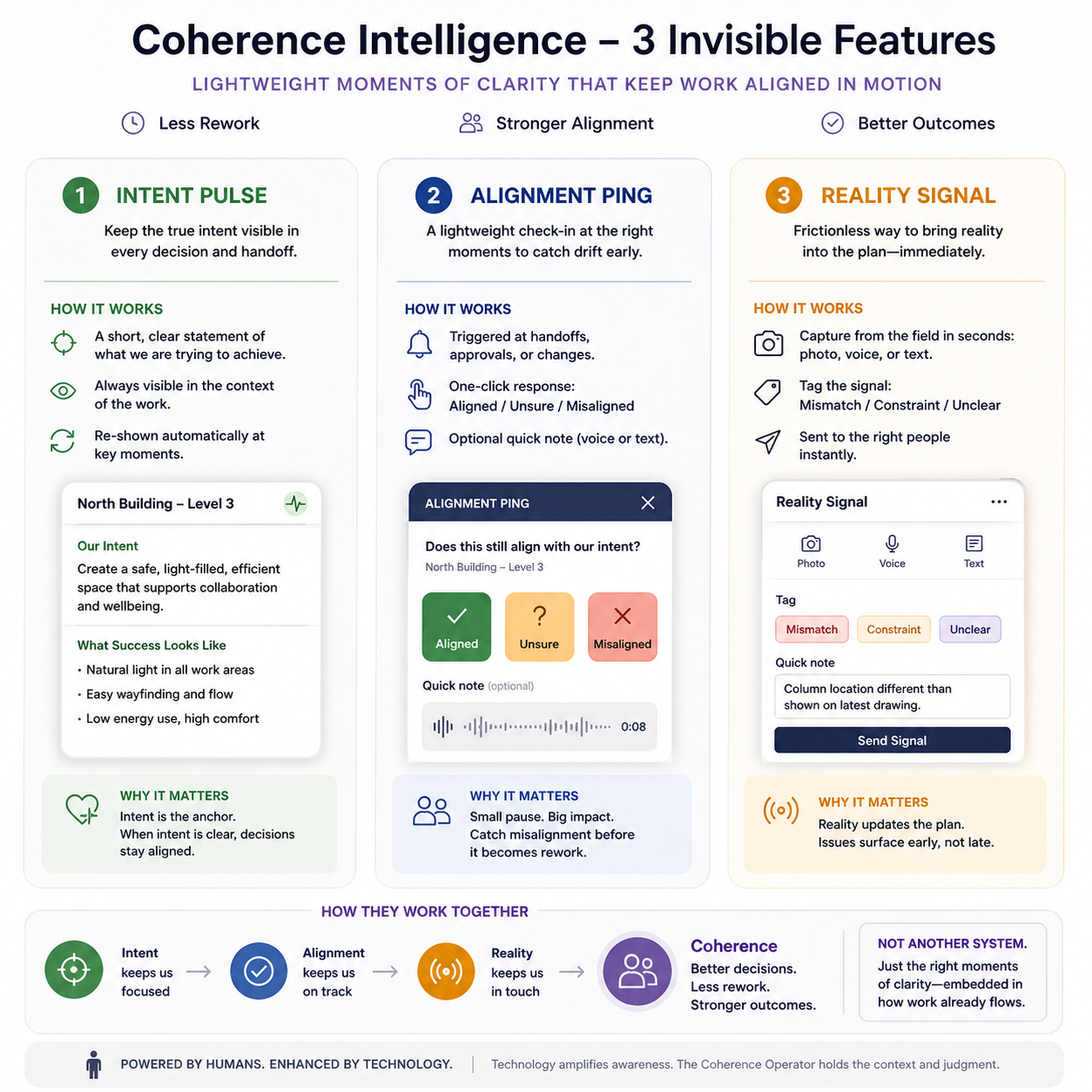
Coherence intelligence
As coherence continues moving from philosophy into practical application, something very simple became visible:
Most systems do not collapse because people lack intelligence.
They collapse because:
intent drifts
alignment weakens
reality changes faster than communication can adapt
And by the time fragmentation becomes obvious,
the cost is already high.
Rework.
Miscommunication.
Conflicting assumptions.
Teams solving different realities at the same time.
⸻
What became clear is that coherence may not require massive new systems.
Sometimes it only requires:
small moments of clarity
inserted at the right places.
Lightweight continuity.
Tiny interruptions to fragmentation before fragmentation compounds.
⸻
Three simple patterns emerged very clearly.
Not as rigid products.
More like:
practical coherence operators.
1. Intent Pulse
The first pattern was simple:
keep the original intent visible.
Not buried in documentation.
Not lost after kickoff meetings.
Not diluted through handoffs.
Just:
clear continuity of purpose.
⸻
Because most teams slowly drift from:
why something exists
into:
managing disconnected tasks.
The moment intent disappears,
fragmentation begins accelerating.
So the idea became:
What if intent remained softly present throughout the entire lifecycle?
Not aggressively enforced.
Simply:
continuously visible.
⸻
A lightweight reminder of:
what matters
what success actually means
what the work is truly trying to create
Not control.
Orientation.
2. Alignment Ping
The second realization:
misalignment usually appears long before failure.
People often sense:
uncertainty
disconnect
friction
drift
before systems formally detect it.
But current workflows rarely create space for those signals to surface early.
So fragmentation grows silently.
⸻
The alignment ping emerged as:
a tiny moment of reflection inserted into workflow.
Not meetings.
Not reporting overhead.
Just:
a simple check.
Does this still feel aligned?
⸻
Not perfection.
Not certainty.
Just:
awareness before compounding distortion.
Because coherence is often maintained through tiny course corrections,
not massive interventions.
3. Reality Signal
The third pattern felt especially powerful.
Reality changes continuously.
Field conditions shift.
Contexts evolve.
Unexpected constraints appear.
But systems often continue operating from outdated assumptions.
⸻
So coherence requires:
reality reaching the system quickly.
Without friction.
Without hierarchy delay.
Without translation collapse.
⸻
The reality signal became:
a lightweight method for reality itself
to update the operational field.
Simple:
photo
voice
text
quick tagging
immediate visibility
Not complexity.
Continuity between:
what is happening
and what the system believes is happening.
⸻
And together these three patterns revealed something deeper.
Coherence may not come from:
more control
more process
more management layers
But from:
maintaining continuity between intent, alignment, and reality as movement unfolds.
⸻
That changes how organizational intelligence is understood.
Because intelligence is no longer just:
optimization
prediction
information management
It becomes:
the ability to reduce fragmentation across evolving systems.
⸻
And perhaps most importantly:
none of this feels heavy.
It feels:
light
adaptive
relational
human
Not another rigid framework.
Not another control architecture.
Just:
the right moments of clarity
embedded into movement itself.
⸻
The deeper realization underneath all of this may simply be:
Coherence is not created through force.
It is protected through continuity.