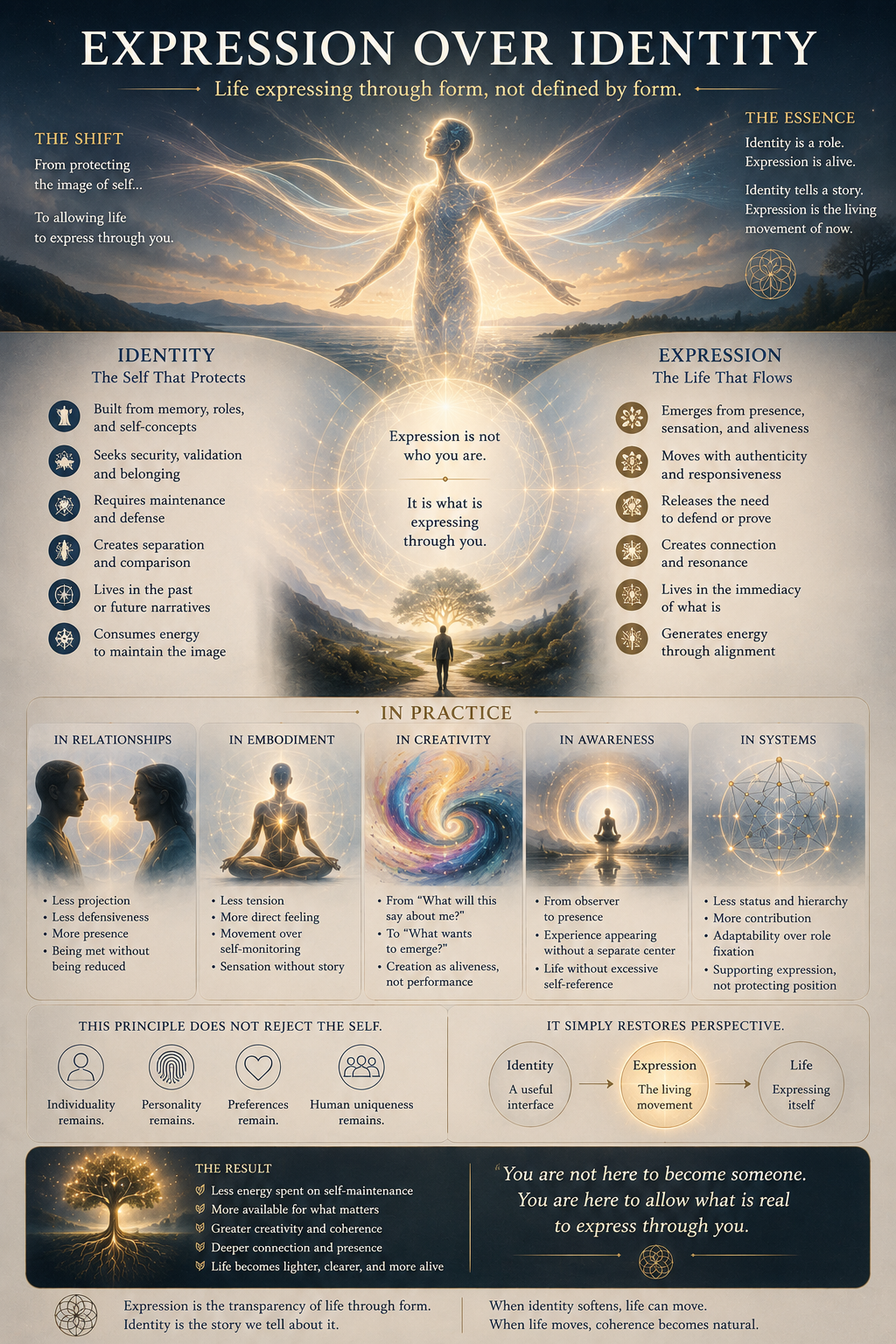
Expression over Identity
Expression Over Identity
One of the shifts repeatedly emerging throughout the Codex is the movement from identity toward expression.
Not the destruction of identity.
Not the denial of individuality.
But the softening of rigid self-construction into something more transparent, fluid, and alive.
Identity is functional.
It helps organize:
memory
communication
navigation
relational continuity
practical interaction
But suffering often increases when identity becomes fixed and heavily defended.
The system begins protecting the image of self rather than remaining available to direct experience.
Energy becomes concentrated around maintaining:
narratives
roles
self-concepts
belonging structures
personal continuity
psychological positioning
Over time, this can create contraction.
Expression feels different.
Expression is alive in the moment.
It does not require permanent definition.
It moves.
Changes.
Adapts.
Reveals.
Expression allows life to move through form without requiring the form to become rigidly identified.
This changes the orientation entirely.
Instead of asking:
“Who am I?”
the movement becomes closer to:
“What is expressing here now?”
Not as performance.
Not as branding.
Not as identity management.
As direct aliveness.
This principle appears across many layers of experience.
In relationships, identity often creates:
projection
defensiveness
interpretation
role maintenance
conflict stabilization
Expression allows:
honesty
immediacy
relational openness
dynamic responsiveness
presence without excessive narrative
In embodiment, identity can create:
bodily tension
self-monitoring
image management
emotional suppression
fragmentation between sensation and expression
Expression allows:
movement
direct feeling
fluidity
responsiveness
greater nervous system continuity
In creativity, identity asks:
“Will this be accepted?”
“What does this say about me?”
“How should this appear?”
Expression asks:
“What wants to emerge?”
“What is moving naturally?”
“What is already alive here?”
This principle also changes the feeling of awareness itself.
At first, many people experience awareness through the structure of an observer:
“I am witnessing experience.”
“I am observing thoughts.”
“I am awareness.”
But eventually even the observer can begin softening.
What remains is not:
experience + observer
but simply:
experience appearing.
Expression without a fixed center.
Movement without a controller.
Life without excessive self-reference.
This does not erase individuality.
Difference remains.
Personality remains.
Preferences remain.
Human uniqueness remains.
But the rigidity surrounding identity softens.
The self becomes lighter.
More transparent.
Less defended.
Less performative.
More available to direct aliveness.
Expression over identity also reshapes systems and organizations.
Many systems currently reinforce identity:
status
hierarchy
role fixation
social positioning
defensive structures
But coherent systems increasingly prioritize:
contribution
relational intelligence
adaptability
responsiveness
continuity of movement
Less:
“protecting position.”
More:
“supporting expression.”
This principle does not reject the human self.
It simply places identity back into its appropriate role:
a useful interface,
not an absolute center.
Over time, expression begins feeling more natural than self-maintenance.
Less energy is spent stabilizing a fixed image.
More energy becomes available for:
creativity
perception
embodiment
connection
coherence
direct living
Expression over identity is not about becoming nobody.
It is about no longer needing to become somebody in order to fully exist.
The movement shifts from:
maintaining self-image
to:
allowing life to express itself more transparently through form.