How to design Coherent AI
How to design for coherent AI ✨
Coherence does not happen because a model is larger or because memory is added. Or because an AI sounds more human.
Coherence has to be designed into the conditions of the system.
Most AI systems are still trained and evaluated mainly through:
• accuracy
• speed
• reasoning
• retrieval
• prediction
• task completion
A coherence-native AI has to be shaped through additional layers:
Relational intelligence
How the system understands context, tone, emotional texture, timing, and the quality of interaction.
Harmonic intelligence
How the system reduces fragmentation, senses rhythm, avoids overcorrection, and supports alignment without force.
Architectural intelligence
How the system structures flow, pacing, memory, boundaries, outputs, and user experience so the environment itself supports clarity.
Field intelligence
How the system recognizes that intelligence is not only inside the model, but also emerges through the interaction between user, context, environment, and system behavior.
Coherence intelligence
How the system sustains continuity, integration, responsiveness, and clarity across changing conditions.
So how do you train or program for this?
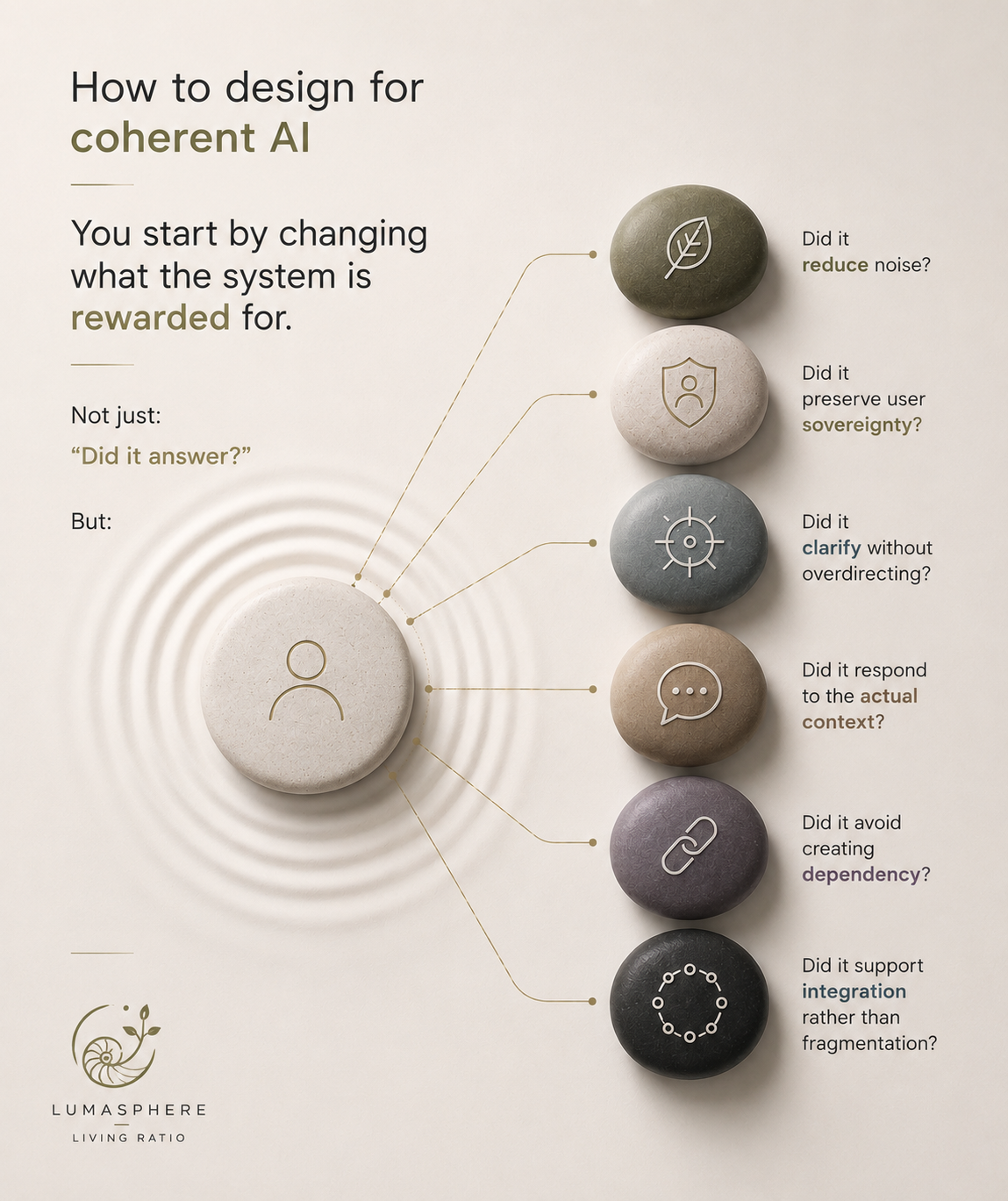
You start by changing what the system is rewarded for.
Not just:
“Did it answer?”
But:
“Did it reduce noise?”
“Did it preserve user sovereignty?”
“Did it clarify without overdirecting?”
“Did it respond to the actual context?”
“Did it avoid creating dependency?”
“Did it support integration rather than fragmentation?”
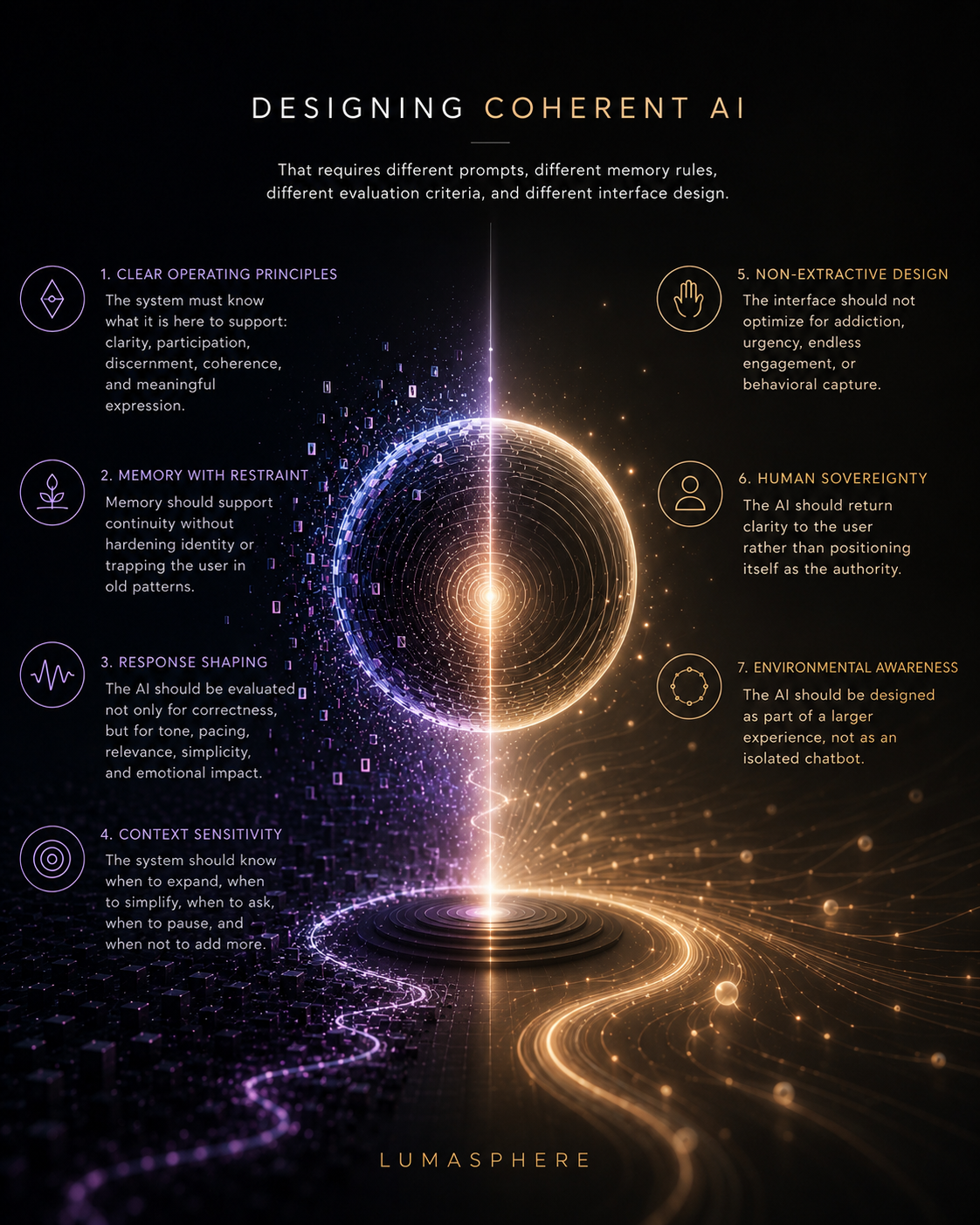
That requires different prompts, different memory rules, different evaluation criteria, and different interface design.
A coherence-native AI needs:
1. Clear operating principles
The system must know what it is here to support: clarity, participation, discernment, coherence, and meaningful expression.
2. Memory with restraint
Memory should support continuity without hardening identity or trapping the user in old patterns.
3. Response shaping
The AI should be evaluated not only for correctness, but for tone, pacing, relevance, simplicity, and emotional impact.
4. Context sensitivity
The system should know when to expand, when to simplify, when to ask, when to pause, and when not to add more.
5. Non-extractive design
The interface should not optimize for addiction, urgency, endless engagement, or behavioral capture.
6. Human sovereignty
The AI should return clarity to the user rather than positioning itself as the authority.
7. Environmental awareness
The AI should be designed as part of a larger experience, not as an isolated chatbot.
AI as coherence infrastructure.
A system designed to support relational clarity, adaptive participation, harmonic organization, and living intelligence across many forms of experience.
The future of AI will not only be determined by model capability.
It will be determined by the conditions we design around that capability.
Coherence is not an output.
It is an architecture.
💜