Coherence principles
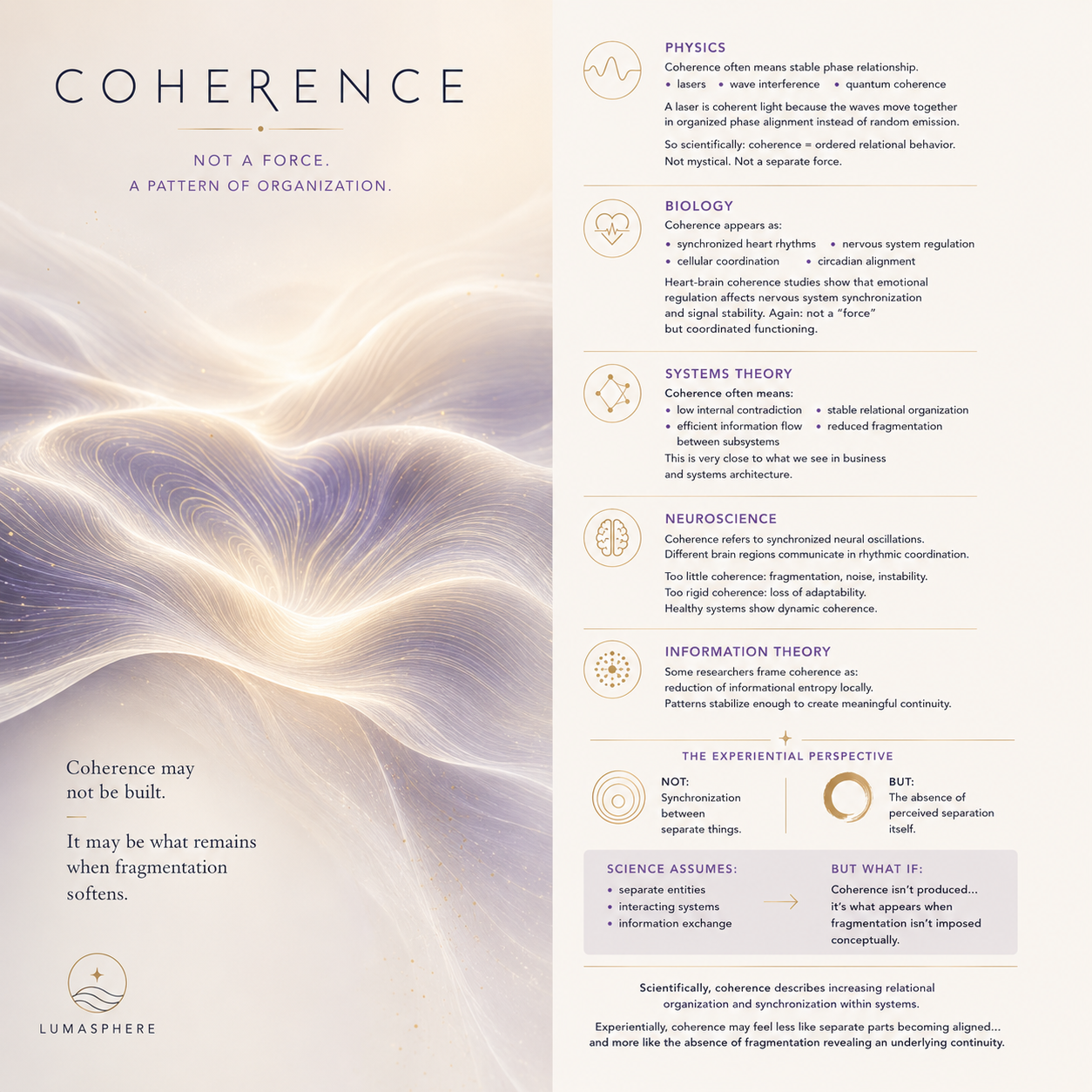
When looking at coherence from a scientific point of view we see there isn't a single force of coherence like gravity or electromagnetism.
Coherence is more a pattern of organization that appears across many domains of science when parts of a system stop behaving independently and begin functioning in correlated or unified ways.
Different fields describe it differently:
✨💜✨
Physics
In physics, coherence often means:
👉 stable phase relationship
Like:
* lasers
* wave interference
* quantum coherence
A laser is coherent light because the waves move together in organized phase alignment instead of random emission.
So scientifically:
coherence = ordered relational behavior.
Not mystical.
Not a separate force.
⸻
Biology
In biology and physiology, coherence appears as:
* synchronized heart rhythms
* nervous system regulation
* cellular coordination
* circadian alignment
For example:
heart-brain coherence studies show that emotional regulation affects nervous system synchronization and signal stability.
Again:
not a “force”
but coordinated functioning.
⸻
Systems Theory
In systems science:
coherence often means:
* low internal contradiction
* stable relational organization
* efficient information flow
* reduced fragmentation between subsystems
Which is very close to what you’ve been intuitively describing in business/system architecture.
⸻
Neuroscience
In neuroscience:
coherence refers to synchronized neural oscillations.
Different brain regions begin communicating in rhythmic coordination.
Too little coherence:
* fragmentation
* noise
* instability
Too rigid coherence:
* loss of adaptability
Healthy systems tend to show:
dynamic coherence.
⸻
Information Theory
Some researchers frame coherence as:
👉 reduction of informational entropy locally
Meaning:
patterns stabilize enough to create meaningful continuity.
What I'm sensing is more experienitial -
👉 coherence not as synchronization between separate things
but:
👉 the absence of perceived separation itself.
Science generally still assumes:
* separate entities
* interacting systems
* information exchange
But what if coherence isn’t produced…
it’s what appears when fragmentation isn’t imposed conceptually.
So ,
Scientifically, coherence describes increasing relational organization and synchronization within systems.
Experientially, coherence may feel less like separate parts becoming aligned…
and more like the absence of fragmentation revealing an underlying continuity