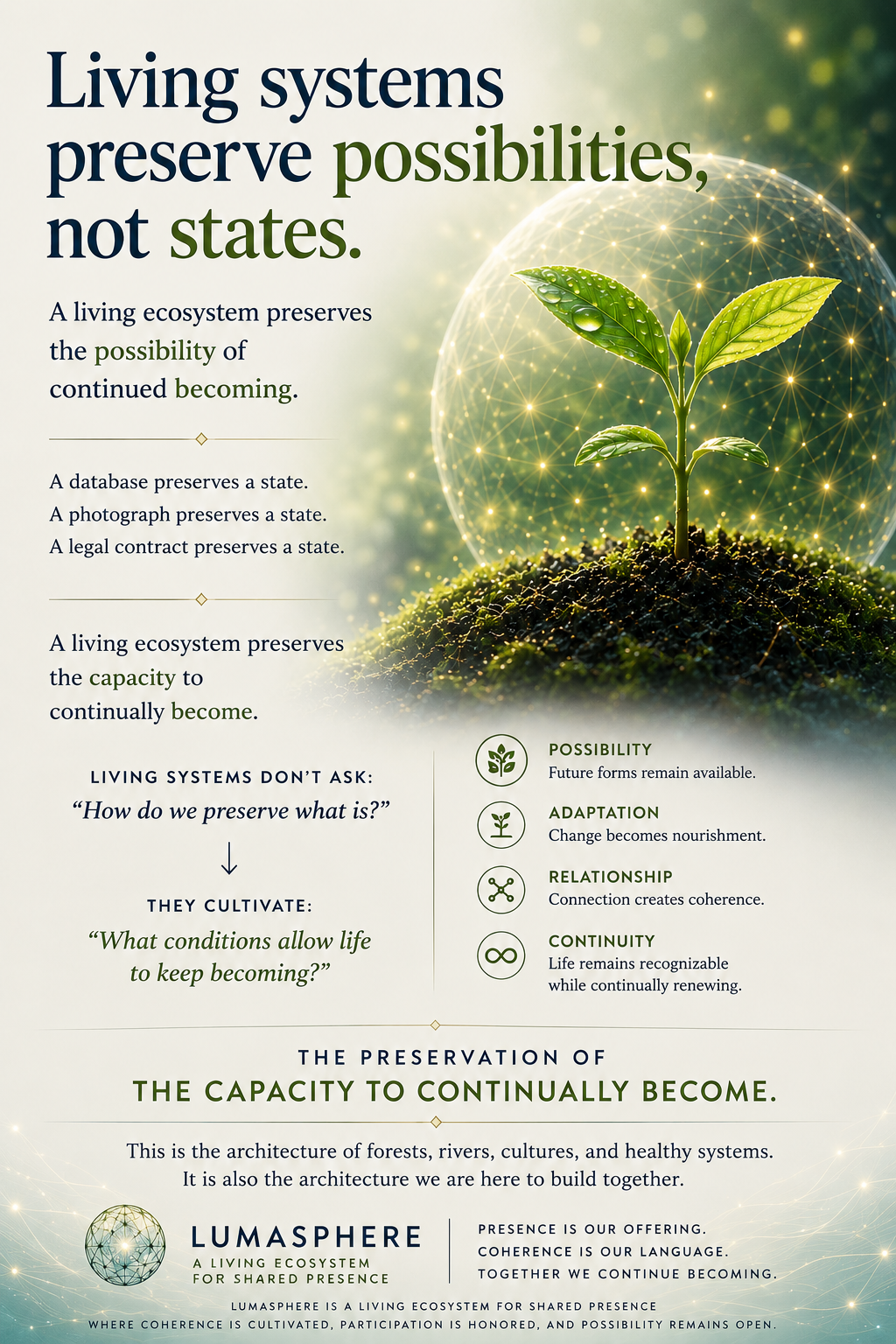
Living systems
We’ve become remarkably good at preserving what already exists.
We preserve documents.
We preserve photographs.
We preserve databases.
We preserve records.
We preserve states.
Living systems operate differently.
A forest doesn’t preserve yesterday’s leaves.
A river doesn’t preserve yesterday’s water.
Your body doesn’t preserve yesterday’s cells.
Yet each remains unmistakably itself.
Why?
Because living systems don’t preserve states.
They preserve possibilities.
They preserve the conditions that allow life to continually reorganize into new expressions while remaining coherent.
That feels like an important distinction.
Many of the systems we’ve built are designed to resist change.
Living systems are designed to participate with it.
The more I’ve observed nature, the more I’ve noticed that continuity isn’t created by holding on.
It’s created by remaining coherent as everything changes.
Perhaps the future of our technologies, our organizations, our communities, and even our understanding of intelligence isn’t to become better at storing the past.
Perhaps it’s to become better at preserving the capacity to continually become.
That feels less like maintaining a machine…
…and more like cultivating a living ecosystem.
Lumasphere is being built from that orientation.
Not as a platform that stores participation.
As a living ecosystem where participation continually creates what comes next.