Designing Coherent Ai
Designing Coherent AI
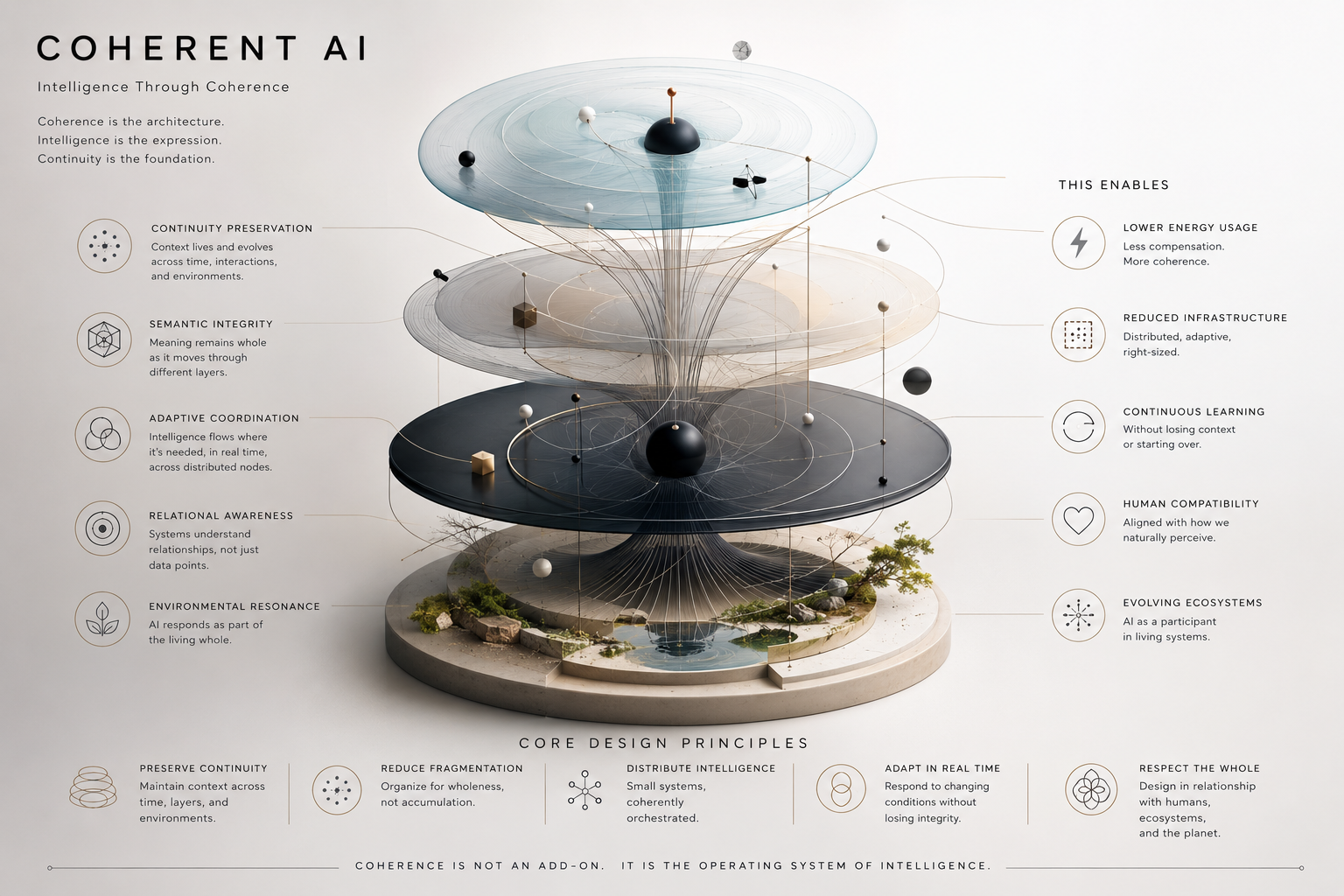
As I continue exploring intelligence architecture, what becomes increasingly visible is that coherence itself is an intelligence principle.
Not conceptually.
Operationally.
Coherent systems preserve continuity across changing conditions while remaining adaptive, responsive, and relationally organized.
And this begins opening a very different direction for AI design.
Coherent AI is not simply about producing intelligent outputs.
It is about maintaining:
- contextual continuity
- semantic integrity
- adaptive coordination
- relational awareness
- environmental responsiveness
- signal preservation across layers
The architecture itself begins behaving more like a living system.
Not static.
Not rigid.
Continuously responsive.
What feels important is that intelligence does not appear only through accumulation.
It also appears through:
- reduction of fragmentation
- continuity preservation
- elegant orchestration
- contextual persistence
- lower redundancy between systems
As coherence increases,
less energy is required compensating for:
- contextual loss
- repeated reconstruction
- fragmented inference
- disconnected memory
- excessive synchronization overhead
The system retains continuity instead of constantly rebuilding it.
This shifts how infrastructure itself can evolve.
Intelligence becomes increasingly:
- distributed
- relational
- context-aware
- adaptive
- semantically continuous
Smaller specialized systems can coordinate coherently instead of requiring endless centralized expansion.
Meaning efficiency itself becomes part of intelligence architecture.
What’s becoming visible is that coherent AI may naturally support:
- lower energy usage
- reduced infrastructure demands
- adaptive local inference
- continuity across environments
- more human-compatible interaction
- responsive semantic ecosystems
Not because intelligence is reduced.
But because fragmentation decreases.
And this extends beyond AI itself.
Because coherence principles appear across:
- nervous systems
- organizations
- ecosystems
- architecture
- communication
- XR environments
- distributed systems generally
Living systems maintain continuity dynamically.
AI architecture may evolve similarly.
What excites me most is that coherent AI feels less like building isolated intelligence…
and more like designing relational intelligence ecosystems capable of evolving while preserving continuity.
That changes:
- infrastructure
- energy scaling
- semantic systems
- human-machine interaction
- adaptive environments
- intelligence itself
And we are only beginning to explore what becomes possible from there.