Coherent ai
Coherent AI
Lately I’ve been exploring another possible direction for AI design.
Not as opposition to current approaches,
but as a different architectural pathway intelligence systems could evolve through.
Much of today’s AI development naturally moves toward:
- larger models
- larger datasets
- larger infrastructure
- larger compute clusters
- increasing energy requirements
This has produced remarkable capabilities.
But it also raises an interesting question:
What if intelligence can scale not only through expansion…
but through increasing coherence and efficiency?
A coherence-oriented approach to AI would focus less on maximizing sheer computational scale and more on:
- continuity
- contextual integrity
- adaptive coordination
- semantic preservation
- relational organization
- reducing fragmentation between layers
Just a different way of thinking about intelligent architecture.
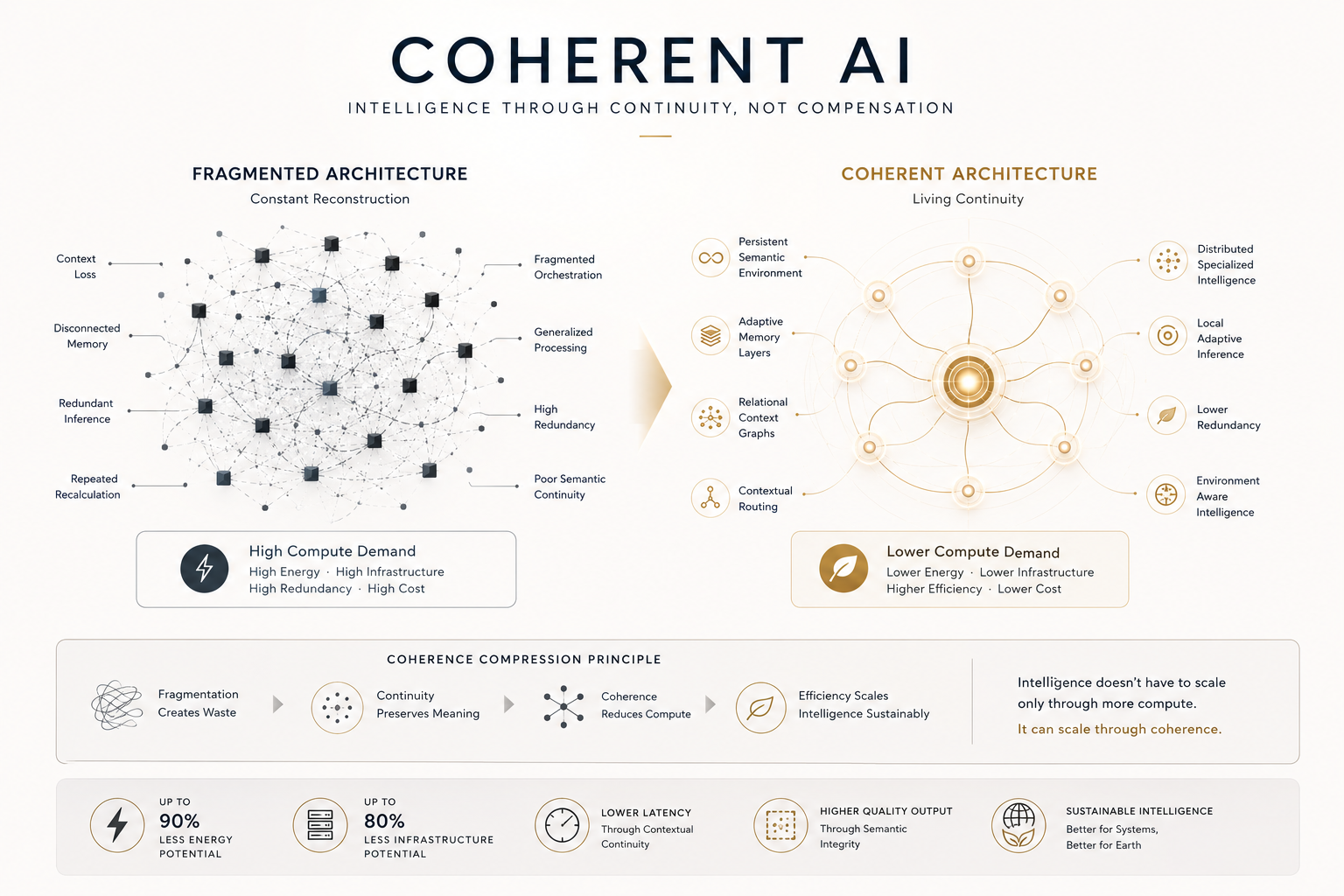
Many current systems spend enormous computational energy compensating for:
- contextual loss
- repeated reconstruction
- fragmented orchestration
- redundant inference
- disconnected memory
- inefficient retrieval
- lack of persistent continuity
Which opens another possibility:
What if a significant portion of computational demand is actually compensation for structural incoherence?
A more coherent architecture might instead emphasize:
- smaller specialized models
- distributed intelligence layers
- contextual continuity preservation
- adaptive semantic routing
- relevance-based memory systems
- local contextual inference
- lower redundancy between systems
- relational coordination instead of repeated reconstruction
Almost like:
intelligence through elegant orchestration rather than escalating infrastructure demands.
If systems preserve:
- continuity
- context
- semantic stability
- relational integrity
then less computation may be required for:
- rebuilding context repeatedly
- excessive retrieval cycles
- corrective inference
- redundant processing
- centralized over-computation
Meaning:
coherence itself could become computationally efficient.
This could fundamentally alter infrastructure requirements over time.
Not necessarily eliminating computation —
but potentially reducing the need for:
- enormous centralized data centers
- constant model expansion
- escalating energy consumption
- increasingly massive infrastructure scaling
Leading instead toward:
- distributed intelligence systems
- adaptive edge inference
- smaller coordinated models
- lower-energy architectures
- context-aware local processing
Potentially:
far greater intelligence with dramatically lower energy requirements.
So perhaps the future of AI is not only about building larger systems.
It may also involve discovering architectures where intelligence emerges through:
- continuity
- coherence
- efficiency
- relational organization
- adaptive contextual awareness
A different trajectory.
Not less advanced.
Potentially:
more elegant,
more sustainable,
and more energy efficient.