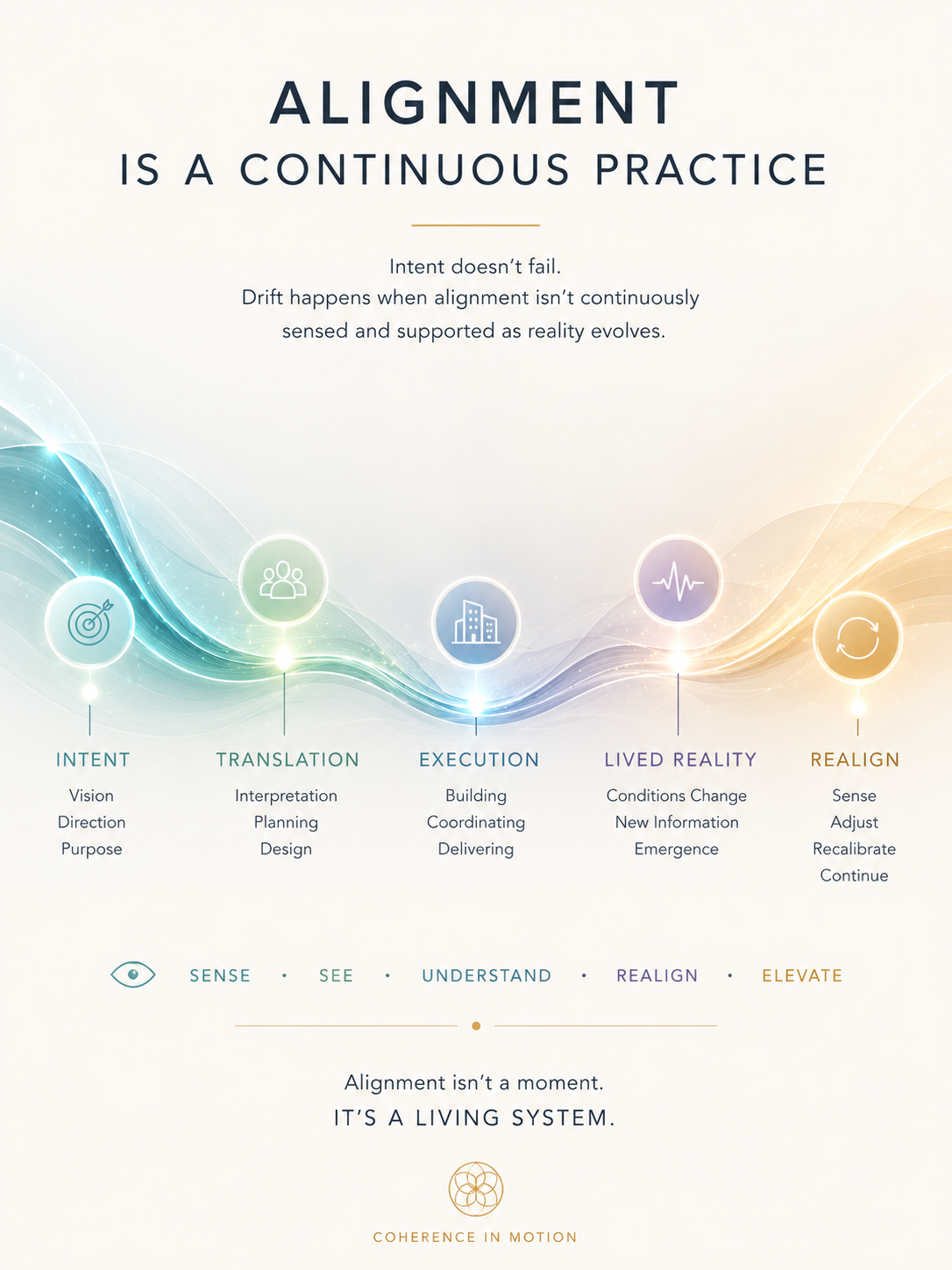
Alignment drift
Alignment drift is becoming one of the most interesting infrastructure concerns of our time.
Not just in construction.
Not just in XR.
Not just in software.
Everywhere.
Because most systems are still designed around static planning…
while reality itself is dynamic.
⸻
A project begins with clear intent.
A vision.
A feeling.
A direction.
Then it moves through:
* stakeholders
* handoffs
* revisions
* timelines
* budgets
* environments
* changing conditions
* different interpretations
And slowly…
drift appears.
Not because anyone failed.
But because most systems don’t actively maintain continuity between:
intent → translation → execution → lived reality
⸻
What’s becoming visible now is that alignment cannot be treated as a one-time event.
It has to become continuous.
Living.
Responsive.
Not tighter control…
but continuous coherence in motion.
⸻
I think this is where a completely new layer begins emerging across industries.
Not management.
Not oversight.
Not optimization.
Something closer to:
coherence intelligence.
⸻
A way of continuously sensing:
* where fragmentation is increasing
* where translation is distorting intent
* where teams are losing shared context
* where reality conditions no longer match the original assumptions
And then gently bringing the system back into alignment before drift compounds into cost, friction, confusion, or rework.
⸻
What’s fascinating is that many people have already been developing these sensitivities for years…
They just weren’t recognized as operationally valuable.
The people who could:
* feel misalignment early
* sense contradiction before visible failure
* detect friction before breakdown
* notice when something “felt off” despite metrics looking fine
Often felt out of place inside traditional systems.
But what if those capacities were never irrational?
What if they were early forms of coherence sensing?
⸻
I think we’re approaching a moment where:
* architecture
* XR
* systems design
* organizational intelligence
* embodiment
* relational dynamics
* operational infrastructure
all begin converging around the same underlying realization:
Fragmentation is expensive.
Coherence scales.
⸻
And maybe the future isn’t about building more complex systems.
Maybe it’s about designing environments where alignment can remain visible as reality evolves.